
By Christina Ison October 7, 2026
Maryland’s 9 percent alcohol tax applies to the taxable price of alcoholic beverages, while Maryland’s general sales-and-use-tax rate is 6% for most other taxable restaurant and retail sales. Hagerstown merchants should therefore configure alcohol and non-alcohol items separately, preserve both tax bases on mixed tickets, and report 9% alcohol sales separately when filing Maryland sales tax.
Tax information verified against Maryland primary sources on October 7, 2026.
For a Hagerstown bar, restaurant, liquor store, caterer, or hospitality business, the maryland 9 percent alcohol tax is not difficult because of the percentage itself. The risk comes from deciding exactly what receives 9%, what stays at 6%, and how the POS handles a single transaction containing both.
A burger with a beer, a dinner package that includes wine, a discounted happy-hour cocktail, a bottle of liquor sold with mixers, or a manager-comped drink can all require different POS treatment.
Maryland Tax-General §11-104 establishes a 9% sales-and-use-tax rate for alcoholic beverages. That 9% rate replaces the ordinary 6% rate on the alcoholic beverage; it is not an extra 3% surcharge added after the 6% tax.
Maryland’s Comptroller confirms the same treatment and specifically covers beer, wine, distilled spirits, mixed alcoholic drinks, frozen cocktails, alcoholic coffee drinks, and other beverages containing at least one-half of 1% alcohol by volume.
For the controlling state rule, merchants can review Maryland’s current Tax-General §11-104 sales-and-use-tax rates.
Maryland 9 Percent Alcohol Tax vs. 6%: Quick Answer Table
A practical Maryland alcohol POS setup begins with product classification.
| Transaction | Typical Maryland tax treatment | POS configuration |
| Draft beer | 9% | Alcohol tax class |
| Bottled or canned beer | 9% | Alcohol tax class |
| Glass or bottle of wine | 9% | Alcohol tax class |
| Liquor pour | 9% | Alcohol tax class |
| Cocktail or mixed alcoholic drink | 9% | Alcohol tax class |
| Frozen alcoholic drink | 9% | Alcohol tax class |
| Alcoholic coffee | 9% | Alcohol tax class |
| Package-store beer, wine, or spirits | 9% | Alcohol tax class |
| Lawfully sold cocktail to go | 9% | Alcohol tax class |
| Separately sold nonalcoholic mixer | Generally 6%, unless otherwise exempt | General taxable class |
| Taxable prepared food | Generally 6% | General taxable class |
| Separately stated qualifying service/labor/property charge related to an alcohol sale | 6% | General taxable class |
| Properly apportioned food-and-alcohol bundle | Food generally 6%; alcohol 9% | Split tax classes |
| Unapportioned lump-sum sale containing alcohol | Higher 9% rate applies | Mixed-package control |
This table captures the central rule behind the Maryland alcoholic beverage sales tax: classify what was sold before calculating tax.
The customer’s payment method does not decide the tax rate. Neither does the terminal, employee, dining area, or whether the customer pays online.
What Exactly Is the Maryland 9 Percent Alcohol Tax?
The maryland 9 percent alcohol tax is Maryland sales and use tax applied to alcoholic beverages.
Maryland’s official alcohol-sales-tax guidance states that the rate changed from 6% to 9% on July 1, 2011. The state expressly says the 9% rate replaced the former 6% rate and was not added to it.
That distinction prevents one of the most serious configuration mistakes.
A merchant should not calculate:
6% general sales tax + 3% alcohol surcharge = 9%.
Instead, the alcohol item itself belongs in the 9% category.
Maryland Tax-General §11-104 also allows certain charges connected with an alcoholic-beverage sale to remain at 6% when they are separately stated and meet the statute’s requirements.
Maryland’s current Alcohol Sales Tax guidance from the Comptroller of Maryland is especially useful when checking mixed beverages, apportioned sales, lump-sum packages, and separately stated charges.
Does Hagerstown Add Another Local Sales Tax?
No general Hagerstown or Washington County retail sales tax is added to Maryland’s state sales tax.
The Maryland Department of Commerce states that Maryland counties and municipalities do not levy general sales or use taxes.
For a typical Hagerstown merchant, that means the key calculation is usually:
- 6% Maryland sales tax on applicable general taxable sales; or
- 9% Maryland sales tax on alcoholic beverages.
The business does not normally add a separate Washington County general sales-tax percentage.
Which Alcohol Sales Take the 9% Rate?
The Maryland 9 percent alcohol tax follows the alcoholic beverage rather than the way the customer consumes or pays for it.
Beer, wine, and liquor sold on premises
A draft beer, glass of wine, whiskey pour, or bottle sold for consumption inside a restaurant or bar is an alcoholic-beverage sale subject to the 9% rate.
For example:
- Draft beer: $8.00
- Maryland alcohol tax: $0.72
- Total: $8.72
The same principle applies to spirits and wine.
Cocktails and mixed alcoholic drinks
Maryland specifically includes drinks containing both alcoholic and nonalcoholic components.
A cocktail does not need to be divided into:
- liquor at 9%; and
- soda, juice, syrup, or garnish at 6%.
The mixed alcoholic beverage is subject to the 9% rate. Maryland’s Comptroller specifically identifies mixed alcoholic drinks, frozen alcoholic cocktails, alcoholic coffee drinks, and gelatin shots containing alcohol.
This is an important rule when building a POS tax code alcohol Maryland restaurants can use consistently.
Package-store sales
A sealed bottle of wine, bottle of spirits, case of beer, or other qualifying alcoholic beverage sold by a liquor store remains subject to 9%.
Off-premises consumption does not change the sales-tax rate.
A Hagerstown liquor store POS should therefore assign alcohol SKUs to the 9% category individually rather than simply applying one tax setting to the entire store.
Cocktails to go
Where the sale itself is lawful under the seller’s alcoholic-beverage licensing rules, a takeout cocktail remains an alcoholic beverage.
The fulfillment method does not convert the drink into a normal 6% sale.
Restaurants should therefore avoid a tax rule such as:
Takeout = 6%
if that rule overrides alcohol item classifications.
The better hierarchy is:
item tax classification first → fulfillment method second.
What About Nonalcoholic Mixers Sold in a Liquor Store?
A liquor store may sell many items that are not alcoholic beverages.
Examples include:
- tonic water;
- cocktail syrup;
- grenadine;
- soda;
- snacks;
- wine openers;
- glassware;
- gift bags;
- bar accessories.
Maryland’s Comptroller specifically explains that a bottle of grenadine or a similar nonalcoholic mixer sold by itself is not subject to 9% merely because it can be mixed with alcohol. Such a sale is generally taxed at 6% unless another exemption applies.
This is why a Hagerstown liquor store POS should classify products SKU by SKU.
Putting the entire “liquor store” department at 9% can overcollect tax on ordinary nonalcoholic merchandise.
Businesses with larger product catalogs can reduce that risk by connecting tax classes with inventory records. Modern integrated POS inventory management can help keep item classification, sales data, inventory movement, and transaction reporting tied together.
Mixed Sale Receipts in Maryland: The Rule Restaurants Cannot Ignore
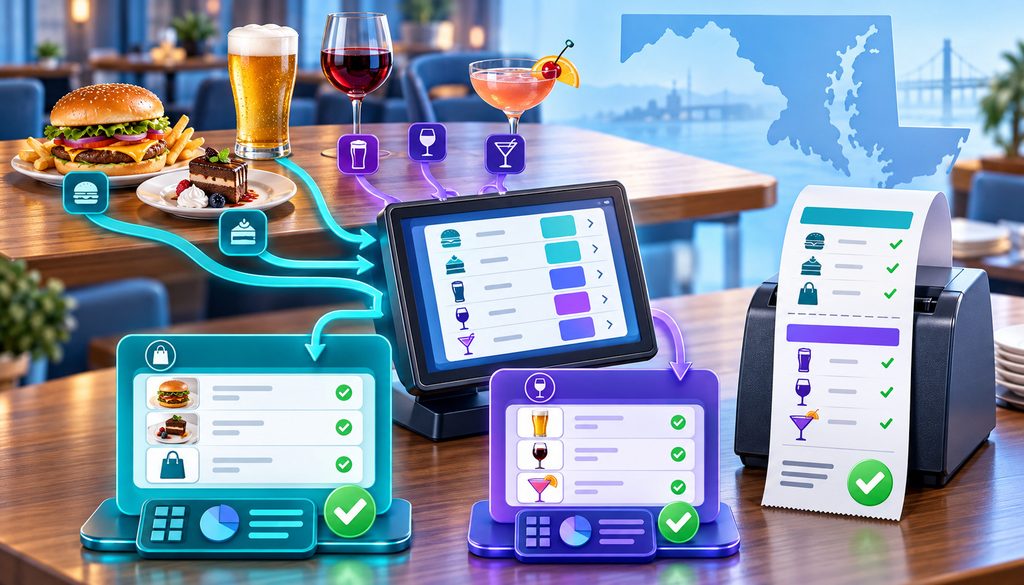
Mixed tickets are where the Maryland 9 percent alcohol tax becomes operationally important.
Maryland permits merchants to apportion the sales price between alcohol and other merchandise. When that happens, alcohol can be taxed at 9% while other taxable items receive the appropriate 6% treatment.
But the Comptroller states that if a merchant charges one lump-sum price and does not apportion the price among alcoholic beverages and other categories, the merchant must collect tax at the higher 9% rate on the lump sum.
Example: normal mixed restaurant ticket
A customer purchases:
| Item | Price | Rate | Tax |
| Burger | $18.00 | 6% | $1.08 |
| Draft beer | $7.00 | 9% | $0.63 |
| Dessert | $8.00 | 6% | $0.48 |
| Cocktail | $12.00 | 9% | $1.08 |
| Total | $45.00 | $3.27 |
The POS should preserve two taxable bases:
6% taxable sales: $26
9% alcoholic-beverage sales: $19
The payment terminal can still authorize one final transaction. The tax detail needs to remain behind the transaction for reporting.
Restaurants handling dine-in, pickup, digital receipts, and online ordering should make sure their restaurant POS system preserves those tax categories across every ordering channel.
Food-and-Alcohol Packages Need Special Attention
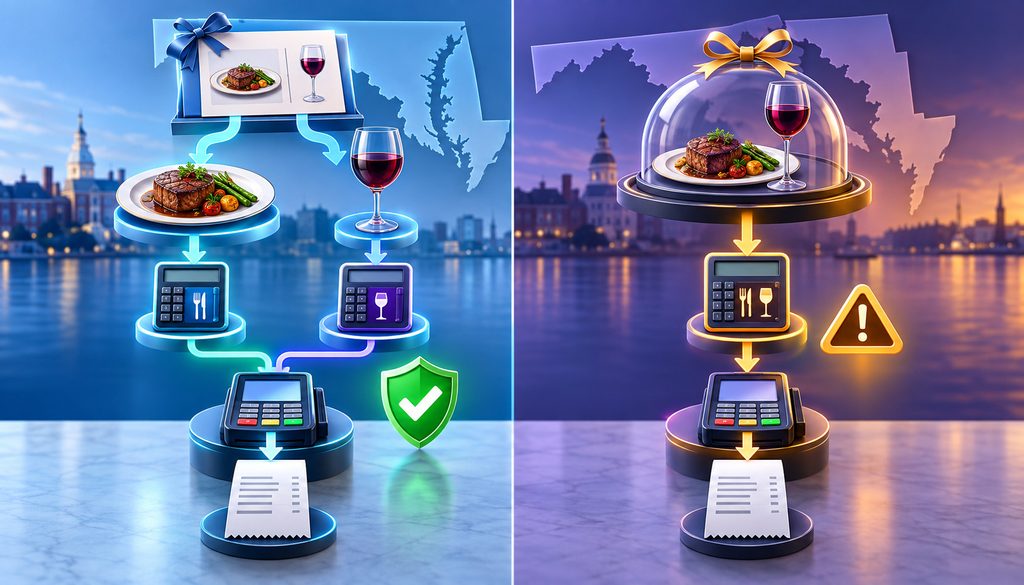
Consider a $60 dinner package containing food and wine.
When the package is properly apportioned
Suppose the merchant maintains a genuine allocation:
- Food: $42
- Wine: $18
The POS could calculate:
- $42 × 6% = $2.52
- $18 × 9% = $1.62
- Total tax = $4.14
When the package is not apportioned
Now suppose the menu simply sells:
Dinner and Wine Package — $60
with no supported division between food and alcohol.
The Comptroller’s published Maryland alcoholic beverage sales tax guidance says that when a seller charges a lump-sum price without apportioning alcoholic beverages and other items, the full amount is subject to the higher 9% rate.
That calculation becomes:
$60 × 9% = $5.40
The merchant should not invent an allocation after the transaction merely to reduce tax.
Pricing, menu setup, receipts, accounting, and POS records should support the same allocation.
Does Maryland Require Sales Tax to Appear Separately on the Receipt?
Yes. Maryland Tax-General §11-302 requires sales and use tax to be stated separately from the sale price and shown separately from the sale price on the record of sale.
That requirement matters for mixed sale receipts Maryland restaurants and retailers issue.
There is, however, a useful distinction.
The statute clearly requires tax to be separated from the sales price. Maryland also requires alcohol sales tax to be separately reported from sales taxed at other rates.
The primary sources reviewed do not clearly establish a universal requirement that every customer receipt containing both tax rates must print one line called “6% tax” and another line called “9% tax.”
Even so, keeping the rates separate inside the POS is the stronger operational design.
A mixed-ticket POS should preserve:
- taxable sales at 6%;
- tax collected at 6%;
- taxable alcohol sales at 9%;
- tax collected at 9%;
- refunds by original tax category;
- discounts;
- comps;
- tax overrides.
That level of detail makes both reconciliation and a future audit easier.
How to Configure a POS Tax Code for Alcohol in Maryland
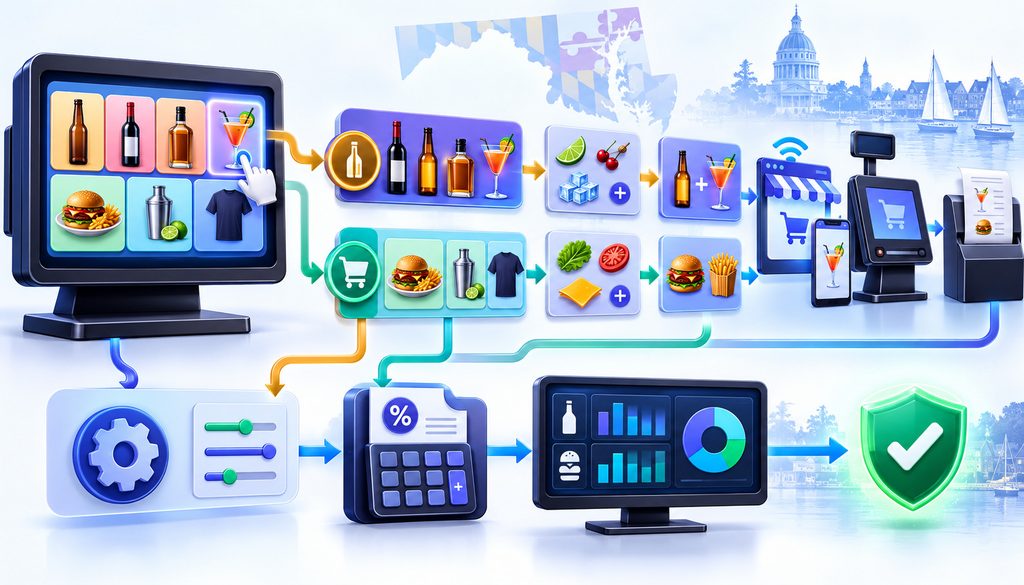
A good POS tax code alcohol Maryland configuration makes the tax decision automatically.
Staff should not need to remember which rate applies while serving customers during a busy shift.
1. Create separate tax groups
At minimum:
MD General Tax — 6%
MD Alcohol Tax — 9%
Additional categories can be created for exempt products or other special tax treatments when needed.
2. Assign the tax class to individual items
For a restaurant:
- beer → 9%;
- wine → 9%;
- liquor → 9%;
- cocktails → 9%;
- alcoholic coffee → 9%;
- taxable food → 6%;
- separately sold taxable nonalcoholic items → 6%.
For a Hagerstown liquor store POS:
- beer → 9%;
- wine → 9%;
- spirits → 9%;
- ready-to-drink alcohol → 9%;
- nonalcoholic mixer → generally 6%;
- taxable snack → generally 6%;
- taxable merchandise → generally 6%.
Do not rely only on broad departments such as “restaurant,” “bar,” or “liquor.”
3. Test modifiers
Modifiers can change tax treatment.
Imagine a café sells regular coffee but lets customers add liquor.
Once the product becomes an alcoholic coffee beverage, Maryland’s guidance places the alcoholic drink within the 9% category.
Test the actual finished transaction rather than assuming the modifier inherits the correct rule.
4. Configure food-and-alcohol combos
A combo containing food and soda is different from a combo containing food and beer.
If the alcohol and food portions are properly apportioned, the tax rates can be applied separately.
If the selling price is an unapportioned lump sum containing alcohol, the higher 9% rule applies under the Comptroller’s guidance.
5. Keep online orders consistent
The same item should normally have the same sales-tax classification whether ordered:
- at the bar;
- through a server;
- at a counter;
- from a kiosk;
- through a QR menu;
- on the restaurant website;
- through an integrated online-ordering channel.
An online-order system should not silently replace the Maryland 9 percent alcohol tax with the default 6% restaurant rate.
6. Restrict tax overrides
Tax overrides should require appropriate staff permissions.
Useful reason codes include:
- exempt transaction;
- classification correction;
- refund;
- transaction correction;
- manager adjustment.
Regularly review the override report.
7. Confirm rate-level reporting
A POS can calculate tax correctly at checkout but still fail operationally if the reporting system combines all taxes into one number.
When comparing platforms, verify that the system can report taxable sales and tax by rate. A broader POS system comparison should include tax classes, modifiers, receipt controls, exports, accounting integration, and historical transaction reporting—not only payment hardware.
Happy Hour Pricing and the Maryland 9 Percent Alcohol Tax
Happy hour changes the selling price, not the tax rate.
Suppose a cocktail normally costs $10 but is sold for $7 during happy hour.
If $7 is the actual taxable selling price, the maryland 9 percent alcohol tax would be calculated on $7:
$7 × 9% = $0.63
The POS should not ordinarily calculate tax on $10 and then subtract the merchant-funded price reduction afterward.
A better workflow is:
- establish the discounted selling price;
- calculate tax on the taxable price;
- preserve the discount in the transaction record.
This also lets management measure the actual cost of promotions without losing the original menu price.
How Store Discounts and Coupons Affect the Taxable Base
Maryland distinguishes between discounts funded by the seller and coupon value for which the retailer is reimbursed.
The Comptroller states that a store coupon generally reduces taxable price when the vendor is not reimbursed by another source. A reimbursed coupon is treated differently because the reimbursement remains part of the consideration received by the seller.
On a mixed 6%/9% ticket, a broad discount should not be dumped automatically into whichever tax category produces the lowest tax.
The POS should apply the discount to the items actually covered by the promotion and preserve the allocation.
For example, a “$3 off appetizers” promotion should not reduce the taxable alcohol base merely because a cocktail appears on the same check.
What About Complimentary Alcohol?
Comps should remain visible in the POS even when the guest pays nothing for the item.
Deleting the item entirely can break:
- inventory counts;
- cost-of-goods reporting;
- manager-comp reporting;
- audit trails;
- potential use-tax review.
A better workflow is:
- ring the drink normally;
- apply an authorized comp;
- record the reason;
- preserve the inventory movement;
- preserve manager approval;
- send appropriate reports to accounting.
Maryland’s sales-tax records rules require vendors to maintain complete and accurate sales and tax records. Those records generally must be kept for four years.
Businesses with high alcohol volumes benefit from POS and inventory systems that can connect comps, returns, stock depletion, and financial reporting rather than treating each as a separate workflow.
Refunds Must Reverse the Correct Tax Rate
A refund should follow the original sale.
If a $20 bottle of wine was taxed at 9%, the original tax was $1.80.
When that transaction is properly refunded, the system should reverse the original 9% tax associated with that item.
A generic refund key configured at 6% can create two errors at once:
- 9% tax remains overstated;
- 6% tax becomes understated.
The same issue applies to mixed restaurant checks.
Refund at the transaction or item level whenever the system permits it so the original tax mapping stays intact.
Reporting Maryland Alcohol Sales Through Maryland Tax Connect
The maryland 9 percent alcohol tax needs to stay separate after checkout because Maryland requires merchants to report alcohol sales tax separately from tax imposed on other sales.
The Comptroller’s current business-tax page provides 2026 sales-and-use-tax forms and electronic filing information.
Businesses should use the Comptroller’s current 2026 Maryland Sales and Use Tax Forms rather than relying on an old return saved from a prior year.
For the Maryland sales-and-use-tax return, alcoholic-beverage sales subject to 9% are reported separately.
That is why a POS should produce a report containing at least:
| Reporting field | Purpose |
| Gross sales | Starting reconciliation figure |
| 6% taxable sales | General taxable category |
| 6% tax collected | General tax liability |
| 9% alcohol sales | Alcohol reporting category |
| 9% tax collected | Alcohol tax liability |
| Alcohol refunds | Supports tax reversals |
| Discounts | Explains changes to taxable price |
| Comps | Supports inventory/accounting review |
| Voids | Separates canceled activity |
| Tax overrides | Identifies manual exceptions |
Do Not Reconcile Sales Tax From the Processor Deposit Alone
Card settlement and taxable sales are different measurements.
The amount deposited into the bank may be affected by:
- processor fees;
- refunds;
- tips;
- chargebacks;
- settlement timing;
- cash transactions;
- gift-card activity;
- split tenders.
The correct reconciliation sequence is:
POS sale → tax category → daily close → accounting records → sales-tax return
not:
bank deposit → estimated taxable sales
Businesses that need to separate card authorization, batching, settlement, and the final bank deposit can review how payment processing and settlement work behind a POS transaction.
Month-End Maryland Alcohol Tax Reconciliation
A practical month-end process looks like this:
- Close the POS reporting period.
- Export gross sales.
- Export taxable sales at 6%.
- Export 6% tax collected.
- Export alcoholic-beverage sales at 9%.
- Export 9% tax collected.
- Review alcohol refunds.
- Review discounts affecting alcohol.
- Review comps.
- Review manual tax overrides.
- Reconcile the POS to the general ledger.
- Resolve unexplained differences.
- Prepare the Maryland sales-and-use-tax return.
- File through Maryland Tax Connect.
- Save the return, filing confirmation, POS reports, and reconciliation.
A multi-location operator should run the same tax mapping at each location and make sure changes are deployed consistently. Cloud POS systems for multi-location businesses can make centralized tax and menu configuration easier, but centralized control still requires careful testing.
Maryland Recordkeeping Rules Matter as Much as the Tax Calculation
Maryland Tax-General §11-504 requires vendors to keep complete and accurate records of retail sales and sales and use tax collected.
Those records generally must be retained for four years.
The Comptroller also says an electronic tax-accounting system should be capable of producing records needed to verify liability and should allow a transaction to be traced backward to its source or forward to reported totals.
For a Hagerstown restaurant or liquor store, that means an auditor should ideally be able to follow:
receipt → POS transaction → daily sales report → monthly tax report → accounting entry → Maryland return
Common Maryland Alcohol Tax Problems for Hagerstown Sellers
Maryland does not publish a special list of “Washington County audit triggers.” The Comptroller says some audits result from information on returns while others may be random.
Rather than inventing an official trigger list, merchants should focus on discrepancies that are difficult to explain during an examination.
Alcohol items accidentally taxed at 6%
A newly created cocktail or beer SKU can inherit the restaurant’s ordinary 6% tax category.
Review newly created products before they go live.
Entire mixed checks taxed at 6%
This usually happens when the POS applies tax to the check instead of individual items.
The maryland 9 percent alcohol tax still needs to apply to the alcoholic-beverage portion.
Unapportioned alcohol bundles taxed at 6%
Maryland specifically warns that a lump-sum price containing alcohol that is not apportioned among categories receives the higher 9% rate.
Online alcohol taxed differently from dine-in alcohol
Tax settings should follow the item.
A cocktail should not become a 6% item merely because it was ordered through a website.
Refunds hitting the wrong tax bucket
Refund the original item or transaction wherever possible.
Missing comp records
A large number of alcohol inventory withdrawals with no corresponding sales, comps, spoilage, or other documented explanation weakens the accounting trail.
Too many manual tax overrides
Frequent overrides may indicate staff training problems or incorrect product setup.
POS reports do not match the Maryland return
The Maryland alcoholic beverage sales tax amount reported to the state should be traceable back to source transactions.
Material unexplained differences deserve investigation before filing.
POS Testing Checklist for Hagerstown Bars, Restaurants, and Liquor Stores
Before the system goes live—and after major menu or software changes—run controlled test transactions.
- Beer only → confirm 9%.
- Wine only → confirm 9%.
- Liquor bottle → confirm 9%.
- Cocktail → confirm 9%.
- Frozen cocktail → confirm 9%.
- Alcoholic coffee → confirm 9%.
- Taxable food only → confirm applicable 6% treatment.
- Nonalcoholic mixer → confirm normal taxable treatment.
- Food plus beer → confirm split rates.
- Food plus cocktail → confirm split rates.
- Properly apportioned dinner-and-wine package → confirm separate bases.
- Unapportioned alcohol package → confirm higher-rate treatment.
- Happy-hour cocktail → confirm tax on discounted taxable price.
- Alcohol refund → confirm original 9% tax reverses.
- Manager comp → confirm transaction and inventory history remain visible.
- Online cocktail → confirm 9%.
- Printed receipt → confirm tax is separate from selling price.
- Daily report → confirm 6% and 9% are separated.
- Month-end export → confirm alcohol sales can be isolated for state reporting.
This testing should be repeated whenever the POS tax code alcohol Maryland setup changes.
Real-World Hagerstown Example
Consider a Hagerstown restaurant with a bar, dine-in service, pickup orders, and a small merchandise shelf.
A customer buys:
- Crab cake entrée: $28
- Draft beer: $7
- Cocktail: $13
- Branded hot sauce: $9
The alcohol base is:
$7 + $13 = $20
The maryland 9 percent alcohol tax on that portion is:
$20 × 9% = $1.80
Assuming the entrée and hot sauce are taxable at 6%, their combined taxable base is:
$28 + $9 = $37
General sales tax:
$37 × 6% = $2.22
Total sales tax:
$1.80 + $2.22 = $4.02
The key is the order of operations:
classify the item → determine taxable selling price → calculate the proper rate → collect payment → preserve rate-level reporting
That process works better than asking the POS to look at the final $57 ticket and guess which single percentage should apply.
Frequently Asked Questions
Is Maryland alcohol tax 9% plus another 6%?
No. The maryland 9 percent alcohol tax replaces the ordinary 6% sales-tax rate on the alcoholic beverage. Maryland’s Comptroller explicitly says the 9% rate is not added to the former 6% rate.
Is beer taxed at 9% in Maryland?
Yes. Beer is an alcoholic beverage covered by the 9% Maryland sales-and-use-tax rate.
Is wine taxed at 9% in Maryland?
Yes. Retail sales of qualifying wine are subject to Maryland’s 9% alcoholic-beverage sales-tax rate.
Are cocktails taxed at 9%?
Yes. Maryland specifically treats alcoholic mixed drinks as subject to 9%, including drinks containing both alcoholic and nonalcoholic components.
Does a Hagerstown liquor store charge 9% on packaged alcohol?
Yes. A sealed bottle or packaged alcoholic beverage does not drop to 6% merely because the customer will consume it away from the store.
Are cocktails to go taxed at 9%?
Where the alcohol sale itself is lawful, the takeout format does not change an alcoholic beverage into a 6% product.
Is a bottle of cocktail mixer taxed at 9%?
Not simply because it is used with liquor. Maryland specifically explains that a separately sold nonalcoholic mixer such as grenadine is generally taxed at 6% unless another exemption applies.
How do I tax food and alcohol on the same restaurant check?
When properly itemized or apportioned, the alcoholic-beverage portion receives 9% while other taxable items can receive the appropriate 6% rate.
Do I need separate 6% and 9% lines on every customer receipt?
The primary sources reviewed clearly require tax to be separated from the sales price and alcohol tax to be reported separately to Maryland. They do not clearly establish a universal rule requiring two separately labeled tax-rate lines on every mixed customer receipt. The POS should nevertheless preserve both rates independently in its transaction and reporting data.
Final Takeaway: Configure the Tax at the Item Level
The maryland 9 percent alcohol tax becomes manageable when the POS makes the tax decision at the product level rather than leaving it to a cashier or applying one rate to an entire check.
Beer, wine, spirits, and alcoholic mixed drinks should reliably flow to the 9% category. Taxable food, separately sold nonalcoholic mixers, merchandise, and qualifying separately stated charges should retain the appropriate Maryland treatment.
Mixed transactions should preserve separate 6% and 9% taxable bases. Food-and-alcohol packages should be genuinely apportioned when the business intends to apply separate rates. Discounts should reduce the correct items. Refunds should reverse the original rate. Comps and overrides should remain visible in the transaction history.
Just as importantly, the Maryland alcoholic beverage sales tax totals in the POS should reconcile cleanly with accounting records and Maryland Tax Connect reporting.
For a Hagerstown bar, restaurant, or liquor store, that combination—accurate classification, consistent POS logic, clear mixed sale receipts Maryland records, and traceable reporting—is the strongest way to turn the maryland 9 percent alcohol tax from a recurring compliance problem into a repeatable operational process.