
By Christina Ison October 7, 2026
Most retailers opening a store in Washington County need a Maryland traders license before selling merchandise. The license is issued through the Clerk of the Circuit Court, normally renews on the May 1–April 30 licensing cycle, and works alongside—not instead of—Maryland sales-tax registration, local zoning approval, resale documentation, and other store-opening requirements.
If you plan to open a retail store in Hagerstown, the Maryland traders license should be near the top of your pre-opening checklist. Maryland requires covered traders to obtain the appropriate license, and the Washington County Circuit Court Clerk specifically lists traders and chain stores among the retail and wholesale businesses it licenses.
The process is not difficult once you understand how the pieces fit together. The confusion usually comes from mixing up the trader’s license, sales-and-use tax registration, a resale certificate, business-entity registration, and Hagerstown zoning approval.
This guide explains who needs a Maryland traders license, how the statutory inventory fee structure works, what a Washington County retailer should prepare before applying, when the license renews, what happens when it lapses, and how licensing fits into the rest of opening a Hagerstown storefront.
Verified against Maryland and Washington County primary sources: October 7, 2026.
Maryland Traders License Requirements: Quick Answer
| Question | What a Washington County retailer should know |
| Who generally needs one? | A person or business operating as a trader and selling goods in Maryland |
| Who issues it locally? | Clerk of the Circuit Court for Washington County |
| Does each store need a license? | Generally, yes |
| What can affect the fee? | Maryland law provides inventory-based and uniform-fee frameworks; confirm Washington County’s current applicable charge with the Clerk |
| Statutory inventory fee range | $15 to $800 outside Baltimore City and Baltimore County where the inventory schedule applies |
| License cycle | May 1 through April 30 |
| Can a midyear license be prorated? | Generally yes, quarterly under Title 17 |
| Is sales-tax registration separate? | Yes |
| Is a resale certificate separate? | Yes |
| Does Hagerstown require zoning approval? | Yes, for a new business or change of commercial tenancy |
| Where should a Washington County retailer start? | Washington County Circuit Court Clerk, Licensing |
The most authoritative local starting point is the Washington County Circuit Court business licensing page. The Clerk advises prospective businesses to confirm which licenses apply because requirements can depend on the exact activity being conducted.
Who Needs a Maryland Traders License?
A Maryland traders license generally applies when a person does business as a trader in Maryland. State law also generally requires a separate license for each store or place of business.
For a normal Washington County storefront, that can include businesses such as:
- Clothing boutiques
- Shoe stores
- Gift shops
- Convenience stores
- Sporting-goods stores
- Home décor retailers
- Electronics stores
- Furniture stores
- Hardware stores
- Auto-parts retailers
- Hobby and collectibles shops
- Beauty-supply retailers
- Packaged-food retailers
- Wholesalers maintaining a local place of business
- Stores that combine physical retail with ecommerce
The requirement is based on the nature of the business, not on whether most customers pay by cash, credit card, debit card, or mobile wallet.
An online sales channel also does not automatically eliminate the Maryland traders license requirement for a business operating a Maryland retail location.
Does every store need its own trader’s license?
Generally, yes. Maryland treats the place of business as important to the license.
A retailer with one Hagerstown storefront should not assume that the same license automatically covers a second location elsewhere in Maryland.
Maryland’s rules also address chain stores. Businesses operating multiple retail stores under the same ownership or general management can face an additional chain-store licensing requirement. The Comptroller identifies that obligation separately from the underlying trader’s licenses.
That becomes important when a small Hagerstown retailer grows from one location to two or three.
Who Is Exempt From a Maryland Traders License?
Not every person selling property is treated as a conventional trader.
Maryland law contains exemptions that include several specific categories, such as:
- Growers, makers, or manufacturers in covered circumstances
- Certain nonresident traveling salespeople or representatives dealing with licensed Maryland traders
- A private individual holding a limited sale of personal effects on the individual’s own property
- Certain qualifying restaurant operations
- Some exhibitors participating in qualifying shows or events
The personal-property-sale exemption is narrow. Maryland’s current Comptroller guidance says a private person may generally hold one public sale of personal effects on their property for no more than 14 consecutive days in a calendar year without obtaining the trader’s license.
What if I manufacture the products I sell?
This is one area where store owners should avoid a broad assumption.
A business that genuinely manufactures its products can be treated differently from a boutique that makes some products but also purchases substantial merchandise from wholesalers for resale.
For example, imagine a Hagerstown candle maker that produces its own candles but also buys mugs, gift boxes, diffusers, décor, and other merchandise for resale. The owner should not assume that calling the business a manufacturer automatically removes every licensing requirement.
The Washington County Clerk itself cautions that determining which business licenses apply can sometimes be complex.
If your business mixes manufacturing, wholesale purchasing, and retail sales, describe the complete operation when you contact the Clerk.
How Much Does a Maryland Traders License Cost?

The Maryland retail license cost question requires one important distinction.
Maryland Business Regulation §17-1807 provides two possible trader’s-license fee structures:
- A uniform fee for a county or municipality that has selected the uniform-fee option; or
- An inventory-based fee tied to stock-in-trade where the inventory method applies.
The Washington County Clerk’s current public page confirms that it issues trader and chain-store licenses but does not publish a county-specific trader fee table.
Because the precise local filing amount can depend on the current licensing treatment, a new Washington County applicant should confirm the final charge directly with Licensing rather than relying on a generic web calculator.
Where Maryland’s inventory schedule applies, however, the statutory inventory-based license fee Maryland retailers see is clear.
Maryland Inventory-Based Trader’s License Fee Scale
| Stock-in-trade value | Statutory fee |
| 0–1,000 | $15 |
| 1,001–1,500 | $18 |
| 1,501–2,500 | $20 |
| 2,501–4,000 | $25 |
| 4,001–6,000 | $30 |
| 6,001–8,000 | $40 |
| 8,001–10,000 | $50 |
| 10,001–15,000 | $65 |
| 15,001–20,000 | $80 |
| 20,001–30,000 | $100 |
| 30,001–40,000 | $125 |
| 40,001–50,000 | $150 |
| 50,001–75,000 | $200 |
| 75,001–100,000 | $250 |
| 100,001–150,000 | $300 |
| 150,001–200,000 | $350 |
| 200,001–300,000 | $400 |
| 300,001–400,000 | $500 |
| 400,001–500,000 | $600 |
| 500,001–750,000 | $750 |
| More than $750,000 | $800 |
The current Maryland statute contains this schedule for jurisdictions outside Baltimore City and Baltimore County when the stock-in-trade method applies.
Maryland Courts also publishes this 15-to-800 inventory scale on several current county licensing pages and describes the calculation as being based on the wholesale value of retail inventory.
What might a Hagerstown storefront pay?
Instead of inventing a “typical Hagerstown store” inventory figure, it is better to show how the statutory schedule operates.
Example: $18,000 of inventory
Under the inventory schedule, $18,000 falls into the 15,001–20,000 bracket.
Fee: $80
Example: $28,000 of inventory
That falls into the 20,001–30,000 bracket.
Fee: $100
Example: $60,000 of inventory
That falls into the 50,001–75,000 bracket.
Fee: $200
Example: $125,000 of inventory
That falls into the 100,001–150,000 bracket.
Fee: $300
These examples are useful for estimating Maryland retail license cost, but Washington County applicants should still verify the actual fee charged for their application with the Clerk.
That qualification matters because Maryland law expressly allows the uniform-fee election described above.
What Inventory Value Is Used for the License?
Where inventory valuation applies, the inventory-based license fee Maryland law is not asking the business owner to guess how much merchandise is sitting on the shelves.
Maryland §17-302 connects a new trader’s-license application to the stock-in-trade reported as inventory on the Business Personal Property Tax Return and allows the Clerk to rely on SDAT certification or another certification acceptable to the Clerk.
Washington County also receives special treatment in the statute for determining the applicable valuation year. For Washington County, the valuation year is the fiscal year that includes May 1 of the calendar year when the license is issued.
That is a much better basis than using:
- Annual sales
- Credit-card processing volume
- Shelf-price revenue
- The amount purchased from suppliers during the year
- The amount the owner hopes to sell
- A rough estimate made while completing the application
Keep the inventory records reconcilable
Inventory values used for licensing should make sense when compared with the business’s accounting and inventory systems.
A store whose POS says it has $130,000 of inventory while its accounting records show $58,000 and its licensing documents show $12,000 should be able to explain the differences.
That is one reason inventory setup matters before opening. A properly configured system can update stock when merchandise is received, sold, returned, exchanged, or transferred. Retailers planning that setup can see how integrated POS systems connect inventory and payment management rather than maintaining separate manual records for every function.
How Do I Get a Trader’s License in Washington County, MD?
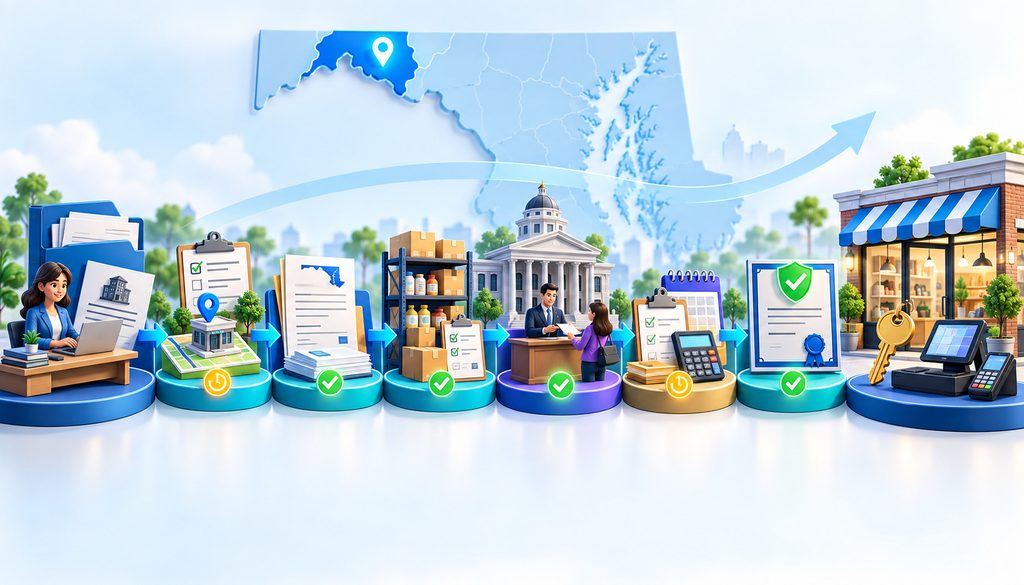
For someone searching trader’s license Washington County MD, the key office is the Clerk of the Circuit Court for Washington County.
The Clerk’s current page lists Traders and Chain Stores, covering retail and wholesale businesses, among the licenses issued locally. It also directs businesses to Licensing when there is uncertainty about which license is required.
A practical application sequence is:
1. Establish the business correctly
Make sure the entity, ownership, registered business name, and Maryland records are in order.
If the store operates through an LLC or corporation, do not assume formation itself is the retail license. Entity registration and the Maryland traders license serve different purposes.
2. Confirm zoning before committing to the property
If you want to open a retail store in Hagerstown, do this before making expensive improvements.
The Washington County Clerk tells businesses to investigate zoning, building permits, and change-of-use requirements before investing time and money in a business property.
Inside Hagerstown, the City requires a zoning certificate for a new business or change in commercial tenancy before the business opens.
The City’s current requirements are available through its Hagerstown zoning certificate information.
3. Register for Maryland sales and use tax
The trader’s license and sales-tax account are separate requirements.
The Comptroller states that, unless an exemption applies, a person may not offer goods for sale in Maryland as a trader without first obtaining a trader’s license and opening a sales-tax account.
Use the Comptroller of Maryland business-license information to confirm the current state registration requirements.
4. Prepare the inventory information
If the inventory-based rules apply to your filing, have the applicable SDAT and business-personal-property information ready.
Do not wait until the licensing counter to reconstruct inventory from invoices.
5. Gather the remaining application information
Depending on the business and filing method, Maryland Courts trader-license instructions commonly call for information such as:
- Business or owner name
- Physical business address
- Mailing address
- Federal tax identification information
- Telephone number
- Sales-and-use tax number
- SDAT account information
- Inventory amount
- Workers’ compensation information where applicable
Maryland Courts’ current county licensing pages show these fields as part of the trader’s-license application process.
6. Apply through the Circuit Court Clerk
The Washington County Clerk lists Licensing as the local point of contact and provides a dedicated business-license contact path.
Confirm the current submission method, amount due, and required supporting documents before filing.
7. Keep the issued license with the store’s compliance records
Do not treat the license application itself as proof that the business has completed the process.
Keep the issued Maryland traders license accessible along with sales-tax, zoning, insurance, lease, and other store records.
When Does a Maryland Traders License Renew?

A trader’s license operates on Maryland’s annual business-license cycle.
The Comptroller states that the license year runs from May 1 through April 30.
That makes April 30 the date every Washington County retailer should put into its recurring compliance calendar.
A practical renewal calendar
February
Review:
- Business entity information
- Inventory records
- Personal-property filings
- Tax accounts
- Business address
- Additional store locations
March
Resolve anything that could block or delay renewal.
Early April
Verify the license information, inventory data where applicable, and amount due.
Before April 30
Complete the renewal instead of waiting for the existing license to expire.
For a growing retailer, repeat the exercise location by location.
Can a Maryland Traders License Be Prorated?
Yes, in qualifying circumstances.
Maryland §17-303 states that, except where another rule applies, the license fee is prorated quarterly when an applicant applies after May 1 for a license that will become effective before the following April 30. The statute also sets a minimum license fee of $2.50.
That is relevant to a store opening in the middle of the license year.
If you plan to open a retail store in Hagerstown in November, January, or February, tell the Clerk the planned effective date and ask for the current prorated calculation rather than estimating it yourself.
What Happens If You Let the Trader’s License Lapse?
A lapsed Maryland traders license can cost more than simply paying the original fee later.
Maryland §17-303 imposes a statutory late fee on a person who is required to have a Title 17 license but does not obtain it on time.
The late fee is:
- 10% of the required license fee for the first calendar month specified by the statute; plus
- 2% of the required fee for each additional calendar month or part of a month.
The total late fee cannot exceed 30% of the required license fee for the license year.
Example
If the required annual license fee were $200:
- 10% initial component = $20
- Each later 2% component = $4
- Maximum statutory late fee = $60
The late charge is added to the underlying licensing obligation.
The practical lesson is simple: do not treat April 30 as a reminder to begin investigating renewal. Treat it as the end of a process that should already be completed.
Maryland Traders License vs. Sales-Tax License vs. Resale Certificate
These documents are often confused because all three may appear during the same retail startup.
They do different jobs.
| Requirement | Purpose | Does it replace the others? |
| Maryland traders license | Licenses covered trading activity | No |
| Maryland sales-and-use tax account | Allows the business to collect and remit Maryland sales/use tax | No |
| Resale certificate | Supports qualifying tax-free purchases of merchandise intended for resale | No |
A sales-and-use tax number is therefore not a substitute for the trader’s license Washington County MD retailers may need.
Likewise, a resale certificate does not authorize a store to operate.
How Does a Maryland Resale Certificate Work?
The Comptroller explains that a sales-and-use tax license is not simply a “tax number” that makes every business purchase tax-free.
For qualifying merchandise purchased for resale, the buyer generally provides the vendor with a resale certificate.
A Maryland resale certificate must include:
- A signed statement that the purchase is intended for resale
- The purchaser’s name
- The purchaser’s address
- The Maryland sales-and-use tax registration number
Businesses dealing repeatedly with the same supplier can also use a blanket resale certificate when appropriate.
Watch the under-$200 rule
Maryland has a useful detail that small retailers sometimes miss.
The Comptroller says a resale certificate generally cannot be used for a purchase under $200 paid by cash, check, or credit card unless the merchandise is delivered directly to the purchaser’s retail place of business, subject to the listed exceptions.
That can matter to a Hagerstown shop owner making frequent small wholesale purchases.
Hagerstown Zoning Comes Before the Grand Opening
For someone researching Hagerstown open retail store requirements, obtaining the Maryland traders license is only one step.
The City of Hagerstown says all changes of tenancy in commercial space, or plans to open a business in property within the City, require a zoning certificate before the business opens.
The City currently lists:
- $125 for a regular zoning certificate
- $50 for qualifying home-based businesses
- $50 for a CC-MU zoning district business
- $400 for specified blanket zoning certificates
The City also warns that open building permits or a required change-of-use process can delay issuance of the zoning certificate.
A commercial space vacant for a year or more may require additional inspection before occupancy.
That is why zoning should be investigated before spending heavily on a buildout.
Check Signage Before Ordering the Sign
A landlord’s permission to place a sign on the building does not necessarily mean the sign has received local approval.
Hagerstown’s current sign-permit information covers permanent and temporary signs and includes specific application requirements. The City says sign permits are usually issued about two to three weeks after a complete application is submitted, though complicated or incomplete projects can take longer.
Include that timing in the opening schedule.
Ordering a custom sign first and checking local requirements later can create an expensive redesign.
Build the POS Around Inventory, Tax, and Checkout
The Maryland traders license gets the licensing side moving, but it does not configure the retail operation.
A store should set up its POS before merchandise starts moving through the business.
At minimum, configure:
- SKUs and product categories
- Variants
- Supplier receiving
- Inventory counts
- Purchase orders
- Returns and exchanges
- Sales-tax categories
- Discounts
- Employee permissions
- Ecommerce inventory synchronization
- Daily reporting
Different stores need different setups. A boutique carrying sizes and colors has different requirements from a convenience store or specialty parts retailer.
Before buying hardware or committing to software, compare the functions that actually matter to the store. A useful decision framework is this POS system comparison for inventory, payments, ecommerce, and reporting.
If You Sell Online Too, Separate Storefront and Ecommerce Costs
Many retailers opening in Hagerstown now expect to sell both over the counter and online.
That changes the payment setup.
An ecommerce sale carries different fraud, gateway, authentication, and processing considerations from a card-present store transaction. Those differences can affect the merchant’s total cost even when both channels feed the same inventory system.
Retailers planning both channels can compare how ecommerce payment fees differ across online and physical sales channels before projecting margins.
That planning is particularly useful when inventory is shared between the website and the Hagerstown storefront.
Test Payment Acceptance Before Opening Day
Do not let the first real customer become the first test of the checkout system.
Before opening, run controlled transactions for:
- EMV chip payments
- Contactless cards
- Mobile wallets
- Debit, if supported
- Refunds
- Voids
- Partial refunds
- Discounts
- Sales-tax calculation
- Printed or digital receipts
- End-of-day batching
- Settlement into the business bank account
Then reconcile the POS total, processor activity, and bank deposit.
If one of those three numbers does not make sense during testing, solve it before sales volume increases.
Add PCI Security to the Opening Checklist
A retailer’s compliance work does not stop after the Maryland traders license is issued.
Card acceptance creates separate security responsibilities.
Employees should not store card details in:
- Spreadsheets
- Messaging apps
- Paper notebooks
- POS notes
- Shared documents
Use supported payment hardware and software, restrict access, and keep the payment environment as limited as practical.
For small retailers building those procedures, the discussion of PCI compliance and chargeback prevention for small businesses explains how payment security connects with everyday operating costs.
Review the Merchant Agreement Before Signing It
The annual Maryland retail license cost may be relatively modest, but payment-processing contracts can create much larger expenses.
Before signing a merchant-services agreement, identify:
- Processing markup
- Monthly account fees
- Gateway charges
- PCI-related charges
- Statement fees
- Batch fees
- Equipment purchase terms
- Equipment leases
- Early termination charges
- Chargeback fees
- Annual fees
- Minimum monthly requirements
- Rate-change provisions
A $100 or $200 license fee is visible. Small recurring processing charges can be harder to notice.
Retailers comparing proposals should review how hidden merchant fees can accumulate inside processing agreements before accepting the first quote.
Washington County Retail Store Pre-Opening Checklist
If your goal is to open a retail store in Hagerstown, this sequence keeps the major dependencies in the right order.
- Choose and register the business structure.
- Confirm the proposed use with Hagerstown zoning.
- Determine whether a change-of-use or building permit is required.
- Register for Maryland sales and use tax.
- Organize SDAT and business-personal-property records.
- Determine the inventory figure required for licensing, if applicable.
- Apply for the Maryland traders license through the Washington County Clerk.
- Check whether another product-specific or industry-specific license applies.
- Complete sign approvals before fabrication or installation.
- Configure products, inventory, tax, and employee permissions in the POS.
- Set up the merchant account and payment hardware.
- Test sales, refunds, batching, and bank settlement.
- Prepare resale certificates for qualifying supplier purchases.
- Create daily inventory and payment reconciliation procedures.
- Calendar April 30 for the trader’s-license cycle.
Following that order reduces the chance that a missing zoning approval or state registration forces a store to delay its announced opening.
Common Maryland Traders License Mistakes
Mistake 1: Thinking an LLC registration is the license
An LLC creates or registers the business entity. It does not automatically satisfy the trader licensing requirement.
Mistake 2: Assuming the fee is based on annual sales
Where the statutory inventory schedule applies, the inventory-based license fee Maryland law uses stock-in-trade—not annual card volume, gross revenue, or the store’s expected sales.
Mistake 3: Treating the sales-tax account as the trader’s license
The Comptroller treats the trader’s license and sales-tax account as separate parts of the retail setup.
Mistake 4: Treating a resale certificate as a license
A resale certificate supports eligible tax-free purchases intended for resale. It does not authorize the store to operate.
Mistake 5: Assuming one license automatically covers every location
Maryland licensing rules distinguish individual places of business, and multi-location retailers can also face chain-store requirements.
Mistake 6: Waiting until April 30 to investigate renewal
Tax or business-record problems are easier to resolve in February or March than on the last day of the licensing year.
Mistake 7: Signing the lease before confirming zoning
The Washington County Clerk specifically warns prospective businesses to check zoning and permit requirements before investing in a property.
Mistake 8: Forgetting that licensing and payment setup are separate projects
The Maryland traders license lets you address the business-licensing requirement. It does not configure the POS, sales tax, card processing, PCI responsibilities, or settlement account.
Frequently Asked Questions
Do I need a Maryland traders license to open a retail store in Hagerstown?
Most conventional retailers selling goods from a Hagerstown storefront should expect to need one unless a statutory exemption applies. Washington County’s Circuit Court Clerk specifically lists traders and chain stores among the businesses it licenses.
Where do I apply for a trader’s license in Washington County, MD?
Apply through the Clerk of the Circuit Court for Washington County. The Clerk’s current information lists Licensing as one of its service areas and directs prospective businesses to the office for license-specific questions.
What is the Maryland retail license cost?
Where the statutory inventory-based fee applies outside Baltimore City and Baltimore County, trader’s-license fees range from $15 to $800, depending on stock-in-trade value. Maryland also allows jurisdictions to select a uniform trader’s-license fee, so Washington County applicants should confirm the current applicable total with the Clerk.
Is the trader’s license fee based on revenue?
No. Under the inventory method, the inventory-based license fee Maryland schedule is tied to stock-in-trade rather than gross annual revenue or payment-processing volume.
When does the Maryland traders license expire?
The normal Maryland trader licensing year runs from May 1 through April 30.
What is the late-renewal penalty?
The statutory late fee begins at 10% of the required license fee and then adds 2% for each additional month or part of a month covered by the statute. The late fee is capped at 30% of the annual required license fee.
Do I need a sales-tax license if I already have the trader’s license?
Generally yes for a conventional retailer making taxable sales. The Comptroller expressly describes obtaining the trader’s license and opening a sales-tax account as separate requirements.
Is a resale certificate the same thing as a Maryland traders license?
No. A resale certificate allows qualifying purchases for resale to be made without paying sales tax to the supplier. It does not replace the business license.
Does selling online eliminate the trader’s-license requirement?
Not automatically. A retailer operating a Maryland store or other covered place of business can still fall under the trader licensing rules even when ecommerce represents a large share of sales.
Maryland Traders License: What Washington County Retailers Should Do Next
A Maryland traders license is one of the core requirements to address when opening a conventional retail operation in Washington County. It should be handled alongside the business’s sales-tax account, SDAT records, local zoning approval, inventory controls, resale documentation, and payment setup—not treated as an isolated form.
For a retailer trying to open a retail store in Hagerstown, the safest sequence is to confirm zoning first, organize the entity and tax registrations, determine the inventory information needed for licensing, obtain the trader’s license Washington County MD requirements call for, and then finish the POS and payment setup before the first live sale.
The Maryland retail license cost can be modest compared with rent, inventory, signage, and payment-processing costs, but allowing the license to lapse creates avoidable penalties and operational risk. Calendar the April 30 deadline, keep inventory and tax records clean, and verify the current fee and filing requirements directly with the Washington County Clerk each licensing cycle.
That gives the store something more valuable than a piece of paper: a clean compliance foundation from the first inventory delivery through the first card settlement and the first annual renewal.