By Christina Ison August 25, 2026
A merchant can serve customers in Maryland, Pennsylvania, and West Virginia from the same POS while still owing different tax amounts on otherwise similar transactions.
The correct tax can depend on where the store is located, where the customer receives the goods or services, whether a local tax applies, what is being sold, and whether the merchant has an obligation to collect tax in that jurisdiction.
That is why a single flat “tri-state tax rate” is usually the wrong architecture. A properly configured tri-state sales tax POS must make tax decisions transaction by transaction instead of treating Maryland, Pennsylvania, and West Virginia as one tax area.
The state-level differences are significant. Maryland currently imposes a general 6% sales and use tax and does not impose general local sales taxes. Pennsylvania imposes a 6% state rate, with an additional 1% in Allegheny County and 2% in Philadelphia on applicable transactions.
West Virginia imposes a 6% state consumers sales and service tax, while many municipalities impose an additional 1%, generally producing a 7% combined rate in those municipalities.
Those numbers are only the beginning. Product taxability, delivery location, marketplace treatment, exemptions, refunds, nexus, and effective dates can all change what the POS should actually do.
Why Tri-State Tax Configuration Is Complicated
The biggest mistake in Cross-Border Commerce in the Tri-State Area is assuming that neighboring states work alike because their headline state rates happen to look similar. Maryland, Pennsylvania, and West Virginia currently all have a 6% general state-level sales or sales-and-use tax rate, but their local-tax structures and taxability rules differ substantially.
Maryland is comparatively simple from a geographic rate perspective because the Comptroller states that Maryland has no general local sales taxes. Special rates nevertheless exist for categories such as alcoholic beverages and certain vehicle rentals, so a Maryland POS still needs product or transaction-specific tax codes rather than one universal 6% setting.
Pennsylvania adds geographic complexity. The state rate is 6%, while Allegheny County adds 1% and Philadelphia adds 2%, giving common combined rates of 7% and 8%, respectively. Pennsylvania also enacted a significant destination-based change to its local sales-tax rules for Philadelphia and Allegheny County.
The Department of Revenue says Act 21 became law on July 12, 2026, applies retroactively to tax years after December 31, 2025, and will not be enforced under the new rules until October 1, 2026. Merchants should therefore verify implementation timing with the Department rather than relying on old point-of-sale logic.
West Virginia introduces a different type of complexity because numerous municipalities impose a 1% municipal sales and use tax. The West Virginia Tax Division maintains the official municipality list and effective dates, and the combined rate for many listed municipalities is 7%.
Product treatment adds another layer. Pennsylvania generally exempts non-ready-to-eat food and most clothing while taxing digital products. Maryland generally taxes clothing but has detailed food rules. West Virginia generally exempts qualifying food and food ingredients for human consumption while taxing prepared food at the regular rate.
Maryland, Pennsylvania, and West Virginia Tax Structure at a Glance
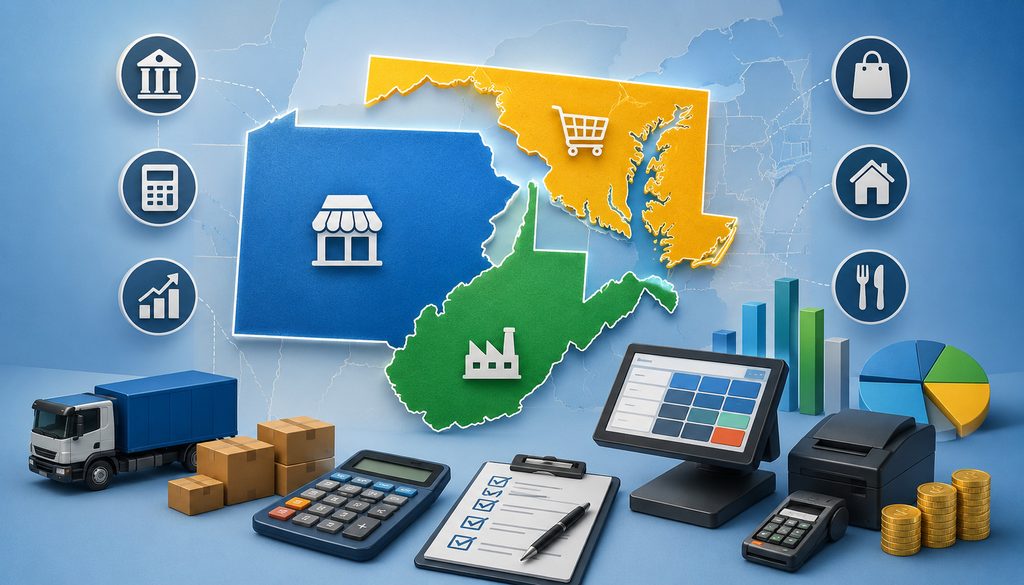
A useful multi-state sales tax setup starts with the official structure of each state, not with a third-party rate chart copied into the POS.
| State | State Sales Tax | Local General Sales Tax? | Important POS Considerations |
| Maryland | 6% general rate | No general local sales tax | Special rates apply to certain categories; taxability rules still vary by product and transaction |
| Pennsylvania | 6% | Yes: 1% Allegheny County; 2% Philadelphia | Local destination sourcing rules require careful address handling; product exemptions are important |
| West Virginia | 6% | Many municipalities impose 1% | Municipal boundaries and destination information can affect the applicable combined rate |
Official sources confirm Maryland’s 6% general rate and absence of general local sales taxes, Pennsylvania’s 6% state rate plus the Allegheny and Philadelphia local rates, and West Virginia’s 6% state rate with municipal taxes generally set at 1% in participating municipalities.
The practical lesson is that POS tax rates by state should not be represented by three static buttons labeled MD, PA, and WV. At minimum, the system needs to understand state, local jurisdiction where applicable, product tax category, fulfillment method, exemption status, and tax effective date.
| Issue | Maryland | Pennsylvania | West Virginia |
| State tax rate | 6% general | 6% | 6% |
| Local tax structure | No general local sales tax | 1% Allegheny; 2% Philadelphia | Participating municipalities generally add 1% |
| Geographic complexity | Lower for general rate | Important in Philadelphia/Allegheny | Important across taxing municipal boundaries |
| Ecommerce considerations | Nexus, delivery, marketplace rules | Nexus, destination, local taxes | Nexus, destination, municipal tax |
| Product taxability | Category-specific | Significant exemptions and taxable digital products | Category-specific; prepared food differs from qualifying groceries |
| Filing authority | Maryland Comptroller | Pennsylvania Department of Revenue | West Virginia Tax Division |
A merchant operating in Hagerstown, a Pennsylvania location, and a West Virginia municipality should therefore keep separate store and jurisdiction profiles even if all locations use the same cloud POS. This aligns with the operational advantages of a centralized multi-location system discussed in this guide to cloud POS systems for multi-location businesses.
Maryland Sales Tax POS Setup
Maryland’s general sales and use tax rate is currently 6%. The Comptroller specifically states that Maryland does not impose general local sales taxes, which means a standard Maryland taxable retail transaction ordinarily does not require the kind of county or municipal add-on used in neighboring jurisdictions.
That simplicity should not lead to one universal Maryland tax code. Maryland has special rates for certain transactions, and product taxability still matters. For example, alcoholic beverages are subject to a 9% sales and use tax rather than the general 6% rate, while certain short-term vehicle rentals have other special rates.
Maryland Product and Food Taxability
Food illustrates why item-level configuration matters. Maryland generally treats food as taxable unless it qualifies under an exemption for a substantial grocery or market business and is intended for off-premises consumption without falling into a taxable prepared-food category.
The Comptroller identifies heated food, party platters, salad-bar food, sandwiches suitable for immediate consumption, and certain small-container frozen desserts as examples that can remain taxable even when sold by a qualifying grocery or market.
Soft drinks, bottled water, candy, confectionery, and alcoholic beverages are also excluded from the food exemption described in that guidance.
Clothing creates another useful tri-state contrast. Maryland’s official tangible-personal-property guidance states that clothing, footwear, and accessories are generally taxable, subject to specific exemptions and temporary tax-free provisions.
A Maryland retail POS might therefore contain separate tax categories such as:
- MD general taxable merchandise
- MD qualifying exempt grocery food
- MD taxable prepared food
- MD alcoholic beverage
- MD exempt/resale transaction
Those classifications should be validated against the Comptroller’s current guidance for the exact products sold.
Maryland Registration and Reporting
Businesses required to collect Maryland sales and use tax should register through Maryland Tax Connect. The Comptroller’s guidance says a permanent sales and use tax license can be obtained through the Combined Registration Application available through that portal.
Sales and use tax returns are generally due on the 20th day following the reporting period. Maryland initially places sales-and-use-tax accounts on a quarterly schedule, but a merchant’s filing frequency can later be changed to monthly, quarterly, semiannual, or annual depending on activity.
The POS should therefore record tax by transaction date and reporting period instead of assuming every Maryland merchant files monthly.
Pennsylvania Sales Tax POS Setup
Pennsylvania’s statewide sales tax rate is currently 6%. The Pennsylvania Department of Revenue’s Sales, Use and Hotel Occupancy Tax guidance confirms the 6% state rate and explains that an additional 1% local tax applies in Allegheny County and an additional 2% applies in Philadelphia.
That produces an applicable combined sales-tax rate of 7% in Allegheny County and 8% in Philadelphia for taxable transactions subject to those local taxes.
This means a Pennsylvania sales tax POS should keep the state component separate from local components. Suggested internal codes might include PA-State-Sales, PA-Allegheny-Local, and PA-Philadelphia-Local.
Separating those codes improves reporting even when the customer sees only one combined tax total.
Pennsylvania Local Sales Tax and Destination Rules
Pennsylvania’s local sales-tax sourcing deserves special attention because the law recently changed. The Department of Revenue states that Act 21 requires vendors already obligated to collect Pennsylvania’s 6% state tax to collect Philadelphia’s 2% or Allegheny County’s 1% local tax on taxable sales made to customers in those jurisdictions.
Pennsylvania recently changed how its Philadelphia and Allegheny County local sales taxes are sourced. The Pennsylvania Department of Revenue’s local sales tax guidance explains that vendors already required to collect Pennsylvania’s 6% state sales tax must also collect the applicable 2% Philadelphia or 1% Allegheny County local tax on taxable sales made to customers in those jurisdictions.
Local tax is now based on the point of destination—where the taxable product or service is delivered—rather than generally on the vendor’s point of sale.
The Department further explains that local tax was previously generally based on the vendor’s point of sale, whereas the new rule is based on the point of destination—where the product or service is delivered.
The legislation was enacted July 12, 2026, with a retroactive statutory effective date, while the Department has announced that enforcement of the new rules will begin October 1, 2026.
This is exactly the kind of rule change that requires effective-dated POS configuration rather than overwriting an old tax rule.
A merchant shipping an order into Philadelphia or Allegheny County should verify current Department guidance for the transaction date and delivery facts. A system that simply asks “Where is the seller located?” may no longer produce the correct Pennsylvania local result.
Pennsylvania Product Taxability
Pennsylvania exempts several categories that merchants may find surprising if they operate primarily in Maryland. The Department lists non-ready-to-eat food, candy and gum, most clothing, textbooks, pharmaceutical drugs, and residential heating fuels among major exemptions.
Prepared restaurant food works differently. Pennsylvania guidance states that food and nonalcoholic beverages sold by an eating establishment generally are taxable whether consumed on the premises or taken out.
Digital products are also an important category. Pennsylvania guidance explains that electronically delivered digital products—including many downloaded or streamed books, videos, music, apps, games, and canned software—are subject to sales and use tax unless another exemption applies.
For state-tax sourcing of digital products, the Department identifies the customer billing address on file as the location used in its guidance.
Restaurants using several ordering channels can benefit from a unified order and reporting setup; this article on restaurant POS systems and multi-channel ordering provides useful operational background.
West Virginia Sales Tax POS Setup
West Virginia imposes a 6% consumer sales and service tax on taxable sales. Unlike Maryland, however, West Virginia authorizes municipalities to impose local sales and use taxes, and many municipalities currently impose an additional 1%.
The West Virginia Tax Division publishes an official municipality-by-municipality list showing effective dates, municipal rates, and combined rates. It currently identifies numerous municipalities with a 1% municipal rate and a 7% combined rate.
That makes West Virginia sales tax POS configuration particularly dependent on reliable jurisdiction identification.
Municipal Tax and Address Accuracy
West Virginia states that municipal sales and use taxes apply to taxable goods, custom software, and taxable services provided within the boundaries of a taxing municipality. The municipal tax generally follows the state tax base, subject to limited exceptions.
For marketplace-facilitated shipments, official guidance specifically says the applicable municipal sales and use tax must be collected when the customer’s shipped-to physical address is inside a municipality imposing the tax.
That demonstrates why a ZIP-code-only lookup can be risky. Postal ZIP codes are designed for mail delivery, not tax-boundary administration. A ZIP may cover addresses inside and outside a municipality.
A cross-border POS should therefore use a validated street address and, when necessary, a reliable jurisdiction-assignment process rather than assuming every customer in a ZIP belongs to the same city.
West Virginia Product Taxability
West Virginia’s general guidance states that the 6% tax applies to tangible personal property and certain services, while qualifying food and food ingredients intended for human consumption are exempt.
Prepared food is treated differently. The Tax Division states that prepared food is subject to the regular 6% state rate and explains that prepared food can include meals sold by eating establishments, heated food, self-service food, and certain combinations prepared by the seller. Municipal tax may also apply where the transaction is sourced to a taxing municipality.
A West Virginia POS should therefore distinguish at least:
- qualifying exempt food
- taxable prepared food
- taxable general merchandise
- taxable services where applicable
- municipal jurisdiction
- exempt customer or resale transaction
What Determines Which State’s Tax Applies?
There is no safe universal rule that says “charge tax based on the customer’s home address.” The correct sales tax sourcing rules depend on where possession or delivery occurs, the type of transaction, the state involved, and sometimes the nature of the product or service.
A better POS design distinguishes the fulfillment event.
In-Store Sales and Store Pickup
Consider a Pennsylvania resident who drives to a store in Hagerstown, Maryland, buys taxable merchandise, and takes the merchandise home personally.
The customer’s Pennsylvania residence does not, by itself, convert the Maryland checkout into a Pennsylvania delivery transaction. The merchant is completing an in-store Maryland sale and transferring possession at the Maryland store. The POS should apply the tax treatment required for that Maryland sale rather than simply reading the customer profile’s home state.
The same principle is why customer-address fields should not automatically override store-location rules for ordinary counter transactions.
Buy-online-pick-up-in-store orders also need a distinct fulfillment code. The online origin of the order does not necessarily mean the sale should be treated the same as a shipped transaction. The important facts include where the customer receives the merchandise and the applicable state sourcing rule.
Shipped and Delivered Orders
Shipped sales require different analysis because the destination can become highly significant.
Suppose a Maryland merchant sells taxable tangible personal property through its own website and ships it to a Pennsylvania customer.
The merchant should determine whether it is registered or required to collect Pennsylvania tax, determine the Pennsylvania destination, determine whether a local Philadelphia or Allegheny component applies, classify the product, and then calculate the applicable tax.
Likewise, a Pennsylvania merchant shipping taxable merchandise to a West Virginia address may need to determine whether the destination lies within a West Virginia municipality that imposes the 1% municipal tax.
A West Virginia merchant shipping merchandise to Maryland needs to determine its Maryland collection obligation and the Maryland taxability of the product. If Maryland tax is due, Maryland’s general 6% structure and Maryland-specific item rules matter—not the rate at the merchant’s West Virginia location.
Local Delivery
Merchant-operated delivery should not be configured as though the customer walked out of the store with the product unless applicable sourcing rules actually support that treatment.
The POS should capture:
- selling location;
- delivery address;
- fulfillment method;
- state and local jurisdiction;
- item tax category;
- exemption status;
- tax code applied; and
- the rule/effective date that produced the result.
This architecture is particularly important for restaurants, furniture retailers, appliance sellers, building-supply businesses, and other merchants serving nearby customers across state lines.
One POS, Multiple Tax Jurisdictions
One POS can support Maryland, Pennsylvania, and West Virginia, but it should contain multiple tax profiles rather than one cross-border commerce tax in one POS percentage.
A useful hierarchy is:
Business Entity → Store/Channel → State → Local Jurisdiction → Product Category → Tax Code
For example:
- MD-State-Sales
- MD-Prepared-Food
- PA-State-Sales
- PA-Allegheny-Local
- PA-Philadelphia-Local
- WV-State-Sales
- WV-Municipal-Martinsburg
- WV-Municipal-[Jurisdiction]
These labels are illustrations, not official tax-code names.
The goal is traceability. Every transaction should explain why it received its tax amount.
Cross-Border POS Tax Configuration Workflow
A strong multi-state POS tax configuration process should include the following steps:
- Inventory every location and channel: List physical stores, warehouses, websites, mobile sales, delivery operations, marketplaces, and temporary locations.
- Identify jurisdictions: Confirm the actual state and relevant Pennsylvania local or West Virginia municipal jurisdiction.
- Determine nexus and registration status: Do not enable collection in a state simply because a customer lives there.
- Verify current rates from official sources.
- Map products and services by taxability: Avoid relying on generic taxable/non-taxable flags across all three states.
- Create separate state and local tax codes.
- Configure sourcing logic for in-store, pickup, shipping, and delivery.
- Configure ecommerce and marketplace channels separately.
- Test realistic transactions before deployment.
- Verify receipts, exports, GL postings, and tax-return reports.
Integrated POS systems are particularly useful when the transaction, inventory, and accounting records remain connected rather than being re-keyed manually. This overview of integrated POS inventory, payments, and financial reporting explains the operational benefits of keeping those data flows connected.
Do Not Use One Combined Tri-State Tax Code
A code such as TRISTATE-TAX-6% may appear convenient because the three state headline rates are currently 6%, but it destroys information needed for compliance.
It cannot reliably identify:
- whether Pennsylvania local tax applies;
- whether West Virginia municipal tax applies;
- which state receives the liability;
- which product exemption was used;
- whether a rate changed;
- whether a refund reverses the right tax;
- which return should include the transaction.
Two transactions can both display 6% and still belong to completely different tax liabilities.
Product Taxability Differences Across the Three States
Rate accuracy cannot compensate for incorrect product classification. A POS charging the correct 6% rate on an exempt item is still wrong.
The safest cross-border POS tax configuration separates the geographic tax rule from the item-taxability rule.
Grocery Food, Prepared Food, and Restaurants
Maryland uses detailed rules for food. Its Comptroller explains that qualifying off-premises food sold by a substantial grocery or market business can be exempt, while prepared items such as heated food, party platters, salad-bar food, and sandwiches suitable for immediate consumption remain taxable in specified circumstances.
Pennsylvania identifies non-ready-to-eat food among major exempt categories. In contrast, food and nonalcoholic beverages sold by eating establishments generally are taxable, including dine-in and takeout transactions.
West Virginia exempts qualifying food and food ingredients intended for human consumption but taxes prepared food at its general rate.
Restaurants operating near state borders should therefore map separate menu or tax categories for dine-in, carryout, delivery, catering, and retail grocery-type merchandise where the underlying law requires different treatment. The fulfillment channel should never silently change the product classification.
Clothing
Clothing is one of the clearest reasons not to copy taxability settings between Maryland and Pennsylvania.
Maryland’s official guidance states that clothing, footwear, and accessories are generally taxable, subject to limited exemptions and tax-free-period provisions.
Pennsylvania, by contrast, lists most clothing among its major sales-tax exemptions.
A retailer with stores in both states should therefore create state-specific clothing tax rules. A SKU marked “exempt” globally because it is ordinary apparel in Pennsylvania could create systematic Maryland undercollection.
West Virginia product treatment should likewise be confirmed against current state guidance rather than inferred from either neighboring state.
Services, Digital Products, Software, and Other Categories
Services require particular care because none of the three states can safely be summarized as “services are taxable” or “services are exempt.” Each state taxes specified services according to its own statutes and administrative guidance.
Pennsylvania specifically taxes certain services and digital products. Its digital-product guidance includes downloaded or streamed media, apps, games, and canned software among common taxable electronic products, subject to exemptions.
West Virginia’s general sales-tax guidance covers taxable tangible property and certain services, and municipal tax generally follows state taxability with limited exceptions.
Maryland similarly has product- and service-specific rules and special tax situations.
For software, SaaS, installation labor, repair services, digital subscriptions, lodging, alcohol, telecommunications, and mixed transactions, merchants should verify the exact category before assigning a POS code.
Ecommerce, Economic Nexus, and Marketplace Sales
Ecommerce changes the scale of Maryland Pennsylvania West Virginia sales tax compliance because one website can create sales into all three jurisdictions without opening three storefronts.
The first question is not simply “Where is the customer?” It is whether the seller has a legal collection obligation there.
Economic and Physical Nexus
Maryland’s published remote-seller guidance requires an out-of-state vendor to register when Maryland-delivered sales exceed $100,000 in gross revenue or reach 200 or more separate transactions during the current or previous calendar year. Maryland’s marketplace guidance also explains how direct and facilitated sales factor into its rules.
Pennsylvania uses a different standard. The Department of Revenue states that economic nexus generally applies when Pennsylvania annual gross sales exceed $100,000 and specifically notes that Pennsylvania uses a sales threshold without a transaction-count threshold.
West Virginia’s guidance identifies a threshold of at least $100,000 in West Virginia gross revenue or 200 or more separate transactions during the current or immediately preceding calendar year for covered remote sellers and marketplace facilitators.
That means a POS or ecommerce platform should not use one “$100,000/200 transactions” formula for all states.
Physical presence can independently create obligations. Stores, inventory, warehouses, offices, and certain business activities can establish nexus even when an economic threshold has not been crossed. Pennsylvania, for example, explicitly warns online retailers that inventory stored at a Pennsylvania distribution or fulfillment center creates Pennsylvania tax obligations.
Marketplace Facilitator Rules
Marketplace transactions require separation from direct website transactions because the marketplace may be responsible for collection.
Maryland requires marketplace facilitators to collect Maryland tax on covered facilitated retail sales, and its guidance says a marketplace seller generally should not collect again when the facilitator has properly collected the applicable tax.
Pennsylvania’s online-retailer guidance similarly explains marketplace-facilitator responsibilities under Pennsylvania nexus rules.
West Virginia requires marketplace facilitators meeting the applicable requirements to collect tax on taxable sales, including applicable municipal tax when a shipped-to address falls within a taxing municipality.
The POS and accounting system should therefore preserve separate fields for merchant-collected tax and marketplace-collected tax. Marketplace sales may still need to appear in state reporting or nexus calculations even when the platform remitted the tax.
| Channel | Who May Collect Tax? | Merchant Reporting Issue |
| Physical store | Merchant | Store jurisdiction and product taxability |
| Merchant website | Merchant if collection obligation exists | Destination, nexus, local jurisdiction |
| Marketplace | Marketplace facilitator on covered sales | Avoid duplicate collection; retain marketplace reports |
| Phone order | Merchant when obligated | Delivery/pickup sourcing |
| Delivery app | Merchant or facilitator depending on legal arrangement | Identify collector and reconcile platform statements |
Tax Engine vs. Native POS Rules, Address Validation, and Effective Dates
Not every merchant needs a separate tax engine. A business with three fixed stores and minimal shipping may be able to maintain reliable tax rules directly in a capable POS.
Complexity increases rapidly when the company has hundreds of taxable SKUs, multiple services, nationwide ecommerce, municipal tax exposure, or frequent destination-based shipments.
| Feature | Native POS Tax Rules | External Tax Engine |
| Basic state rates | Usually strong | Strong |
| Local jurisdictions | Varies | Often more automated |
| Destination sourcing | Varies by platform | Often a core capability |
| Product taxability | May require manual mapping | Often provides broader tax-category libraries |
| Multi-state scale | Good when complexity is moderate | Often better for high jurisdiction volume |
| Filing support | Usually reporting-oriented | May offer filing integrations |
The decision should be based on complexity, control, auditability, and integration quality rather than vendor marketing.
Why ZIP-Code-Only Tax Logic Can Fail
ZIP codes are postal constructs, not perfect tax-jurisdiction boundaries. This matters especially when a local tax depends on whether an exact address is inside a taxing municipality.
West Virginia’s official municipal rules are tied to municipal boundaries, and its marketplace guidance references the customer’s shipped-to physical address when determining municipal sales tax.
Pennsylvania’s new local-tax rules make the destination important for Philadelphia and Allegheny County transactions as well.
A more reliable workflow validates:
- street address;
- city;
- state;
- ZIP;
- county or municipality;
- jurisdiction identifier; and
- tax-rule effective date.
The tax result should then be stored with the order instead of recalculated later from whatever rate happens to be current.
Managing Rate Changes Safely
Every tax-rate record should include an effective date.
A useful location matrix is:
| Location | State | County/City | State Rate | Local Rate | Combined Rate | Effective Date |
| Hagerstown location | MD | Washington County | 6% | 0% general local | 6% | Verify current official source |
| PA location | PA | Exact county/city | 6% | If applicable | Calculated | Verify current official source |
| WV location | WV | Exact municipality | 6% | If applicable | Calculated | Verify current official source |
When a rate or sourcing rule changes:
- verify the official notice;
- create a future-effective rule;
- test representative transactions;
- preserve the old rule;
- document who approved the change;
- verify the first live transactions after activation.
Never rewrite the tax rate stored on historical transactions merely to make the database match today’s rate.
Exemptions, Refunds, Returns, Discounts, Shipping, and Gift Cards
Correct sales-tax compliance extends well beyond the initial checkout. Exempt customers, refunds, exchanges, coupons, shipping charges, and cross-location returns all influence the final liability.
Exempt Sales and Certificates
Resale, government, nonprofit, and other statutory exemptions vary by state and transaction type. A certificate accepted in one jurisdiction should not automatically be treated as a universal tri-state exemption.
The POS exemption record should store:
- customer or organization name;
- state;
- exemption type;
- certificate/form identifier;
- issue or review information;
- applicable products or transactions;
- documentation reference; and
- employee or process that approved the exemption.
West Virginia guidance, for example, recognizes exemption certificates and direct-pay permits for specified exempt transactions and explains that a properly executed certificate can relieve the vendor of collection responsibility.
Pennsylvania likewise requires appropriate exemption documentation for covered exempt organizations and transactions.
Do not assume interstate resale-certificate reciprocity without checking each state’s current requirements.
Refunds and Cross-State Returns
The safest refund workflow connects the refund to the original transaction. If $40 of taxable merchandise is refunded from a $100 purchase, the tax reversal should relate to the tax originally calculated on the refunded taxable amount.
This becomes especially important when an item purchased in one state is returned to a store in another.
For example, merchandise purchased at a Maryland store and later returned at a Pennsylvania location should not simply be run through the Pennsylvania store’s current sale-tax engine as a negative Pennsylvania sale. The POS should retrieve the Maryland original transaction and reverse the applicable Maryland tax treatment through the system’s configured return process.
An exchange may require two accounting events: a reversal of the original sale and a new sale of the replacement item. The new transaction may have different tax consequences if fulfillment or jurisdiction changes.
Coupons, Freight, and Gift Cards
Coupon treatment can also affect the taxable base. Maryland distinguishes store coupons from reimbursed manufacturer-type coupons in its guidance, while Pennsylvania restaurant guidance shows how properly identified discounts can alter taxable purchase price.
Shipping and delivery charges should likewise be mapped under state-specific rules rather than globally classified. West Virginia, for example, says municipal sales tax applies to shipping and handling charges in covered marketplace transactions.
Gift cards generally should be treated separately from taxable merchandise because the taxable event commonly occurs when the card is redeemed for taxable goods or services rather than merely when stored value is purchased.
Pennsylvania restaurant guidance expressly identifies gift-card sales as non-taxable while noting that tax remains due on taxable food bought with the card.
Tax Reconciliation by State and Local Jurisdiction
A well-configured POS does not end its job when a receipt prints. The tax data must reach the accounting system and ultimately the correct state return.
The control chain should be:
POS Tax Collected → State/Local Tax Liability → Accounting → Return → Payment
Payment and operational integrations can make this process easier when transaction and accounting data remain connected. Merchants evaluating broader ecommerce integrations may also find this discussion of managing ecommerce payments across sales channels useful for understanding the reporting implications of multiple channels.
Tri-State Tax Liability Report
A monthly report should resemble:
| State/Jurisdiction | Taxable Sales | Exempt Sales | State Tax | Local Tax | Refund Adjustments | Net Liability |
| Maryland | N/A general local | |||||
| Pennsylvania | ||||||
| PA – Allegheny | ||||||
| PA – Philadelphia | ||||||
| West Virginia | ||||||
| WV municipalities |
The report should also allow drill-down to individual transactions.
Daily review should compare taxable sales, exempt sales, tax collected, refunds, marketplace orders, and store totals. Large variances should be investigated while transaction details are still easy to retrieve.
Monthly Reconciliation Workflow
A practical monthly process is:
- export POS sales by state and jurisdiction;
- separate direct sales from marketplace sales;
- verify exemptions and certificates;
- reconcile returns and refunds;
- compare tax calculated with tax collected;
- reconcile each tax bucket to the general ledger;
- compare POS totals with draft state returns;
- investigate discrepancies before filing.
General-ledger liability accounts should remain separate, for example:
- Maryland sales tax payable;
- Pennsylvania state sales tax payable;
- Pennsylvania local sales tax payable;
- West Virginia sales tax payable;
- West Virginia municipal sales tax payable.
Sales tax collected is not operating revenue. Combining tax with sales revenue makes financial statements harder to understand and makes filing reconciliation unnecessarily difficult.
Filing Maryland, Pennsylvania, and West Virginia Sales Tax
A multi-state merchant should never assume the three states use the same filing frequency, portal, due date, or return structure.
Maryland Filing
Maryland sales-and-use-tax businesses register and file through Maryland Tax Connect. The Comptroller states that returns are due on the 20th day following the reporting period and that filing frequency can be assigned as monthly, quarterly, semiannual, or annual depending on the account and activity.
The POS report should therefore align with the merchant’s assigned Maryland filing period rather than a hard-coded monthly calendar.
Pennsylvania Filing
Pennsylvania businesses can register for sales-tax obligations and file through myPATH. The Department’s online-retailer guidance directs sellers with Pennsylvania economic nexus who file themselves to obtain a sales-tax license through the Pennsylvania Online Business Tax Registration process.
Pennsylvania filing can involve state tax plus Allegheny or Philadelphia local tax. The Department’s payment specifications also recognize monthly, quarterly, and semiannual sales-tax filing frequencies, so merchants should follow the filing schedule assigned to their own account.
The recent Pennsylvania local destination rule makes it especially important to validate POS reporting and jurisdiction allocation before the new enforcement date rather than waiting for the first return to reveal configuration errors.
West Virginia Filing
West Virginia vendors register with the Tax Division and file through MyTaxes. Current state guidance says vendors collecting more than $250 per month generally remit monthly, those averaging no more than $250 may file quarterly, and businesses with annual aggregate sales and use tax of $600 or less may qualify for annual filing. Returns generally are due on the 20th day following the reporting period.
Municipal sales and use taxes are administered by the West Virginia Tax Division and reported through the state process rather than paid independently to every municipality.
Filing frequency can change, particularly for remote sellers and marketplace facilitators, so the merchant should rely on the Tax Division’s assigned frequency.
Audit Readiness and Common Tri-State POS Tax Mistakes
Cross-border tax compliance becomes much easier when a business can reproduce the logic behind any transaction months or years later.
The records supporting a multi-state sales tax reconciliation should include POS transaction detail, store-location profiles, tax-rate history, destination addresses, item tax categories, exemption documentation, marketplace statements, refund history, state returns, payment confirmations, GL entries, and tax-configuration change logs.
A tax-change log might contain:
| Field | Detail |
| Jurisdiction | State/city/municipality |
| Previous rate | Rate before change |
| New rate | New official rate |
| Effective date | Legal or administrative effective date |
| Official source | State/local authority notice |
| Updated by | Employee or administrator |
| Tested by | Reviewer |
| Test result | Passed/exception documented |
Common errors include:
- using one flat tax rate for all three states;
- assuming a customer’s home address controls an in-store sale;
- ignoring Pennsylvania’s local tax;
- ignoring West Virginia municipal tax;
- assigning tax by ZIP code alone;
- copying Maryland settings into Pennsylvania or West Virginia locations;
- assigning one product-taxability flag to all states;
- failing to monitor nexus;
- collecting tax again on marketplace sales already taxed by the facilitator;
- using the return-store tax rate for a cross-state refund;
- overwriting old rates instead of preserving effective dates;
- combining all sales-tax liabilities in one GL account; and
- relying on an outdated third-party tax-rate spreadsheet.
Cross-Border POS Tax Checklist
| Area | Verified? |
| Maryland state rate | ☐ |
| Pennsylvania state rate | ☐ |
| Pennsylvania local rate if applicable | ☐ |
| West Virginia state rate | ☐ |
| West Virginia municipal rate | ☐ |
| Store locations mapped | ☐ |
| Delivery sourcing configured | ☐ |
| Product tax categories | ☐ |
| Nexus registrations | ☐ |
| Marketplace treatment | ☐ |
| Exemption certificates | ☐ |
| Refund rules | ☐ |
| Effective dates | ☐ |
| State-specific GL accounts | ☐ |
| Filing reports tested | ☐ |
Questions worth asking a POS provider or tax professional include whether the system can maintain state and local components separately, determine tax from a validated delivery address, vary product taxability by state, preserve historical rates, identify marketplace-collected tax, support cross-state returns, export liabilities by jurisdiction, and document tax-setting changes.
Frequently Asked Questions
What are the sales tax rates in Maryland, Pennsylvania, and West Virginia?
Maryland’s general sales and use tax rate is currently 6%. According to the Maryland Comptroller’s sales and use tax guidance, Maryland businesses required to collect sales tax can register for a permanent sales and use tax license through Maryland Tax Connect.
The same official guidance should be used to verify the current statewide rate before changing a Maryland POS tax profile.
West Virginia’s state consumers sales and service tax is 6%, and many municipalities impose an additional 1%, commonly creating a 7% combined rate. Special products or transactions can have different treatment, so these figures should not be used as universal tax codes.
Does Pennsylvania have local sales tax?
Yes. Pennsylvania currently imposes an additional 1% local sales tax in Allegheny County and 2% in Philadelphia on applicable transactions. Pennsylvania recently changed how local sales tax is sourced: Department of Revenue guidance says the local tax now follows destination rather than generally following the vendor’s point of sale.
The Department has announced that enforcement of the new destination rules begins October 1, 2026. Merchants processing deliveries into those jurisdictions should verify current implementation instructions before changing production settings.
Does West Virginia have municipal sales taxes?
Yes. Many West Virginia municipalities impose a 1% municipal sales and use tax in addition to the 6% state tax. The West Virginia Tax Division maintains the official list of participating municipalities, effective dates, municipal rates, and combined rates.
Because tax is tied to municipal boundaries, merchants processing deliveries should not assume that every address sharing the same ZIP code belongs to the same taxing municipality.
Does Maryland have a local general sales tax?
No. The Maryland Comptroller’s current guidance states that Maryland has no general local sales taxes. The general state sales and use tax is 6%.
However, special rates apply to certain categories and transactions, including alcoholic beverages and specified vehicle rentals, so businesses still need item- and transaction-specific tax configuration rather than one unrestricted Maryland tax code.
How do I configure all three states in one POS?
Use separate tax profiles under a hierarchy such as business entity → store or sales channel → state → local jurisdiction → product category → tax code.
Maryland, Pennsylvania, and West Virginia tax liabilities should remain distinct even when two transactions happen to produce the same percentage. The system should also capture fulfillment method, destination address, exemption status, marketplace status, and tax-rule effective date.
Which tax rate applies when a Pennsylvania customer shops at a Maryland store?
A Pennsylvania home address does not automatically make an ordinary counter purchase a Pennsylvania sale.
When the customer purchases taxable merchandise at a Maryland store and takes possession there, the transaction should be analyzed under Maryland’s applicable rules rather than automatically switching to Pennsylvania tax simply because the customer lives across the state line. The merchant should separately analyze transactions involving seller delivery or shipping.
Which tax applies when goods are shipped across state lines?
The answer depends on the destination state’s sourcing rules, product taxability, and whether the seller has an obligation to collect there.
A Maryland merchant shipping to Pennsylvania, for example, must evaluate Pennsylvania nexus and registration, product taxability, destination, and applicable Philadelphia or Allegheny local tax. A shipment into a West Virginia taxing municipality may require both state and municipal tax.
Do online orders use the store rate or the delivery-address rate?
There is no universal rule for every transaction. Online orders picked up at a store can have different sourcing facts from orders shipped to a customer.
Destination is especially important for shipped transactions and for local tax systems such as West Virginia municipal tax and Pennsylvania’s destination-based local rules. The POS should distinguish shipping, local delivery, and store pickup rather than applying one ecommerce tax setting.
How does economic nexus affect tri-state merchants?
Economic nexus can require a remote seller to collect tax even without a traditional storefront in the customer’s state. Maryland currently uses a $100,000 revenue or 200-transaction standard for covered remote activity.
Pennsylvania generally uses a sales threshold exceeding $100,000 without a transaction-count threshold. West Virginia uses $100,000 or 200 transactions for covered remote sellers and facilitators. Physical nexus can create obligations independently.
Do marketplaces collect sales tax for merchants?
Major marketplace facilitators may have the legal responsibility to collect tax on covered facilitated sales, but merchants should not treat every platform transaction identically. Maryland, Pennsylvania, and West Virginia each have marketplace rules.
The merchant should keep records showing which platform collected tax, which transactions were direct, what sales remain reportable, and whether marketplace activity affects nexus calculations.
Can one product be taxable in one state but exempt in another?
Yes. Clothing provides a useful example: Maryland generally taxes clothing, footwear, and accessories, while Pennsylvania identifies most clothing as exempt. Food and digital-product rules also differ. For that reason, the POS should map SKUs to state-specific tax categories rather than using a single taxable/exempt flag for every location.
How should cross-state returns be handled?
Whenever possible, retrieve the original transaction and reverse the original tax rather than applying the tax rate of the store accepting the return.
A Maryland purchase returned at a Pennsylvania location, for example, should not automatically become a negative Pennsylvania taxable transaction. The POS should preserve the original jurisdiction, tax code, taxable amount, and tax collected so the refund reduces the correct liability.
How should Maryland, Pennsylvania, and West Virginia taxes be reconciled?
Reconcile by state and local jurisdiction rather than by company-wide tax total. Compare taxable sales, exemptions, marketplace sales, refunds, tax collected, and GL balances with each draft state return.
Pennsylvania local liabilities and West Virginia municipal liabilities should remain identifiable. Differences should be investigated before filing rather than rolled into a generic adjustment.
Should state and local tax use separate POS codes?
Usually, yes. Separate codes make reporting and audit trails clearer. Pennsylvania state tax can be distinguished from Philadelphia or Allegheny local tax, while West Virginia state tax can be distinguished from municipal tax.
Even when the checkout receipt displays one combined amount, the back-office system should retain the components necessary for accounting and filing.
What records should a tri-state merchant retain for a sales-tax audit?
Keep detailed POS transactions, store and channel identifiers, destination addresses where relevant, tax-rate history, product taxability mappings, exemption certificates, marketplace statements, refunds, returns, state filings, payment confirmations, GL reconciliations, and configuration-change logs.
Each tax setting should ideally have an effective date and an official source so the company can explain why a transaction received its original tax result.
Conclusion
Managing cross-border commerce tax in one POS is not about finding a single Maryland Pennsylvania West Virginia tax rate. It is about building a transaction-level decision process that recognizes location, destination, item taxability, nexus, exemptions, marketplaces, refunds, and local-tax rules.
Maryland currently uses a 6% general sales and use tax without general local sales taxes. Pennsylvania uses a 6% state rate plus 1% in Allegheny County and 2% in Philadelphia, with recently changed destination-based local-tax rules requiring close attention. West Virginia uses a 6% state rate while many municipalities add 1%.
The strongest POS integration for multi-state commerce therefore separates states, local jurisdictions, tax categories, sales channels, marketplace transactions, and liability accounts while preserving effective-date history. Full addresses should support jurisdiction determination for deliveries, and refunds should remain connected to original transactions.
Most importantly, the POS should be treated as the first stage of the compliance process rather than the final authority. Tax settings should be reconciled to accounting records and state returns, and every material configuration change should be documented and tested.
Tax and legal informational disclaimer: This article provides general operational information and is not tax, accounting, or legal advice. Sales-tax laws, administrative interpretations, local jurisdictions, product classifications, nexus rules, and filing requirements can change. Merchants should confirm current requirements with the Maryland Comptroller, Pennsylvania Department of Revenue, West Virginia Tax Division, applicable local authorities, and a qualified tax professional before implementing or changing POS tax settings.