
By Christina Ison August 25, 2026
Warehouses, trucking companies, and distribution businesses often accept very different types of payments for very different transactions.
A driver may use a fleet or fuel card for an operational purchase, while a shipper may pay a five-figure invoice by ACH or commercial card weeks after delivery. The payment system has to support both fast transaction acceptance and accurate B2B reconciliation.
That challenge is especially relevant to I-81 corridor businesses. The Federal Highway Administration has historically identified I-81 as one of the nation’s major freight corridors, with warehouses, distribution centers, terminals, and other freight-generating facilities playing an important role in corridor activity.
For I-81 corridor distribution centers and transportation businesses, payments frequently cross operational boundaries: counter sales, fuel-related purchases, warehouse invoices, recurring transportation charges, accessorial fees, and remote invoice payments may all flow through different systems.
Payment acceptance is only half the problem. Logistics businesses also need enough payment information to determine which customer, load, shipment, warehouse account, vehicle, fuel transaction, or invoice the money belongs to.
The best payments for trucking businesses are consequently not determined by one lowest-cost payment method. A strong setup combines suitable payment rails with secure collection, useful commercial data, reliable remittance information, fraud controls, and disciplined reconciliation.
Why Payments Work Differently in Trucking, Warehousing, and Distribution
Transportation and warehousing businesses generally operate in a more complicated payment environment than consumer retail.
Instead of selling a $40 product to an anonymous shopper and closing the transaction immediately, a carrier might complete transportation services today, finalize accessorial charges later, invoice a corporate customer, and receive one payment covering several loads weeks afterward.
Common logistics transactions can include:
- line-haul freight charges;
- fuel and fleet purchases;
- warehouse storage;
- cross-docking;
- pick-and-pack activity;
- loading and unloading;
- detention or other contractually applicable accessorial charges;
- maintenance and repair;
- recurring distribution services;
- merchandise or parts;
- deposits or prepayments;
- transportation coordination; and
- account-based commercial purchases.
Many customers also purchase on negotiated terms rather than paying at the point of service. Net 15, Net 30, Net 45, or another term may be agreed contractually, but no particular payment term should be treated as universally standard or legally required.
This creates several distinct payment needs. A warehouse counter may benefit from a card-present terminal. A shipper paying an invoice remotely may prefer ACH. Another business customer may use a purchasing card or virtual card. A fleet customer may expect the terminal to accept a specialized fleet product and capture vehicle or driver information.
The I-81 corridor adds geographic complexity. Businesses may operate facilities in Maryland, Pennsylvania, West Virginia, Virginia, Tennessee, or other states reached by the route. Merchant profiles, settlement accounts, tax configurations, surcharge restrictions, and local reporting structures may therefore differ by location.
The operating objective should be consistent even when the payment method changes: capture enough trustworthy information at the start of the transaction to reconcile the payment efficiently at the end.
Payment Methods Commonly Used by Logistics Businesses
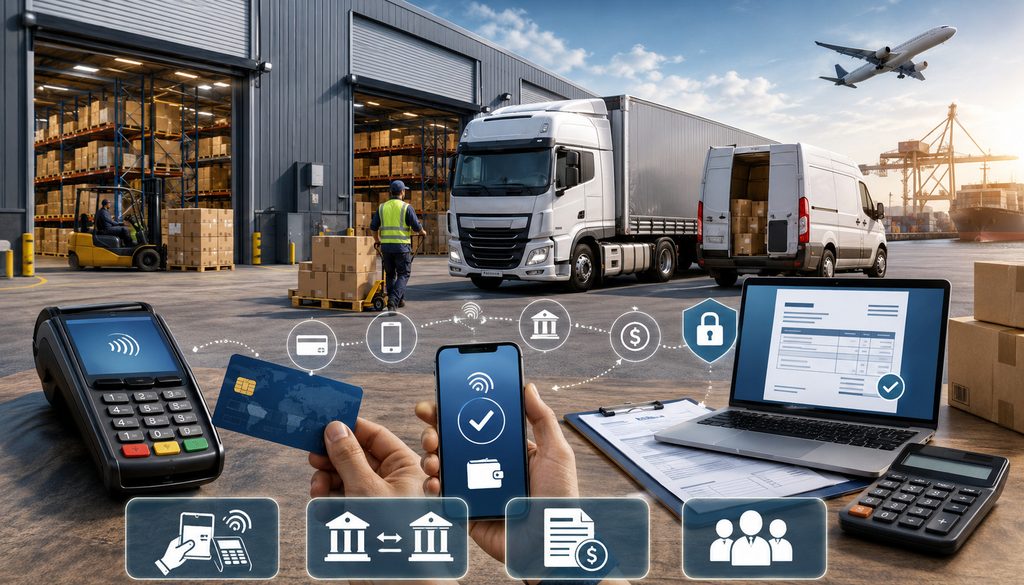
No single payment method fits every warehouse, carrier, wholesaler, or distribution operation. Most businesses need a mix based on transaction size, customer preference, payment location, fraud risk, and accounting requirements.
| Payment Method | Typical Use | Key Operational Issue |
| Fleet card | Vehicle-related purchases | Network and POS compatibility; additional fleet data |
| Fuel card | Fuel and related purchases | Acceptance network, restrictions, driver/vehicle prompts |
| Commercial credit card | B2B invoices and business purchases | Fees, CNP risk, commercial-data qualification |
| ACH | Larger or recurring B2B invoices | Authorization, bank information, returns, remittance matching |
| Check | Traditional account customers | Mail delay, deposit handling, manual reconciliation |
| Wire | Large or time-sensitive payments | Bank instructions, fraud controls, remittance matching |
| Online invoice payment | Remote commercial customers | Secure links, invoice references, card/ACH integration |
The right mix frequently depends on customer behavior. A trucking company with national shippers might receive ACH and virtual-card payments, while a maintenance facility serving fleets could encounter specialized fleet products at the counter.
Commercial cards themselves are not one category. A corporate card, purchasing card, ordinary business credit card, fleet card, and virtual card can have different controls and data capabilities. Likewise, “fuel card” may describe proprietary, closed-loop, fleet-oriented, or network-branded products.
Businesses should therefore avoid configuring payment acceptance from assumptions such as “we accept Visa, so we accept every fleet card.” Acceptance depends on the card program, network participation, processor/acquirer capability, merchant configuration, merchant category, terminal or POS functionality, and relevant network rules.
For a broader explanation of merchant processing structure, this overview of merchant accounts and payment infrastructure provides useful background on how the merchant account, processor, card network, and bank interact.
Fleet Cards, Fuel Cards, and Ordinary Commercial Cards
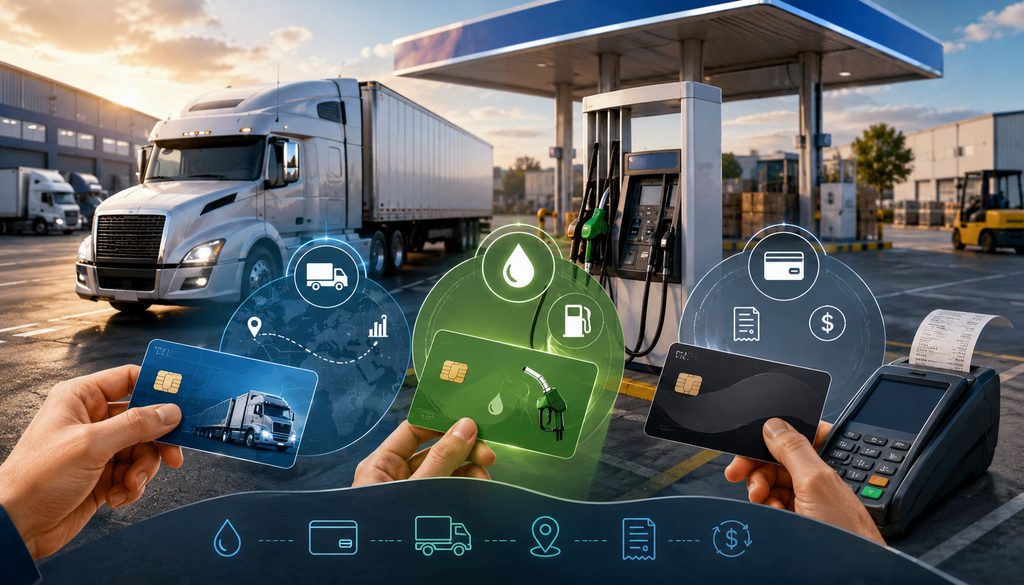
Fleet cards are payment products designed around business vehicle expenditures. Depending on the particular program, they may help a company control or report expenses by driver, vehicle, transaction type, location, fuel purchase, or other fleet-related information.
Visa’s published fleet guidance, for example, describes enhanced data capabilities for participating fuel merchants and identifies possible information such as vehicle or driver identification, purchase type, fuel information, odometer data, and tax-related information. Those examples should not be interpreted as universal fields required by every fleet program.
What Is a Fleet Card?
A fleet card is generally intended to give an organization more control and reporting around vehicle-related business expenses than an ordinary consumer payment card provides. Depending on the issuer and program, controls can be associated with permitted spending categories, drivers, vehicles, purchase types, or account policies.
The card may operate on a broad payment network or through more specialized acceptance arrangements. Some fleet programs can provide enhanced transaction information that makes reconciliation easier for a fleet manager because the expense can potentially be connected to a particular unit, employee, fuel purchase, or service event.
That does not mean every merchant that accepts ordinary cards is automatically prepared for fleet card payments. The processor may have to support the product, the merchant may have to be correctly configured, and the terminal may need to recognize the card and request applicable data.
Businesses evaluating fleet payment processing should therefore ask about specific networks and specific terminal behavior rather than asking only whether “fleet cards” are supported.
What Is a Fuel Card?
Fuel cards overlap with fleet cards but should not be treated as a synonym for them. A fuel card may be designed primarily for fuel purchases and may use a proprietary or closed-loop acceptance system, a broader payment network, or another fleet-oriented architecture.
Restrictions may be important. A program could limit transactions to fuel, certain products, participating merchants, approved locations, or specific spending categories. Other programs may allow maintenance or related fleet purchases.
Commercial fuel cards along I-81 may appear at truck stops, fuel merchants, service locations, maintenance operations, or businesses supporting transportation fleets. Whether a particular merchant can accept one depends on program participation and its processing setup.
The safest practice is to obtain the exact network or card-program name from customers and ask the processor or acquirer to verify support. The terminal should then be tested using the intended transaction type instead of relying exclusively on a compatibility statement.
Fleet Card vs. Standard Commercial Card
| Feature | Fleet Card | Standard Commercial Card |
| Fleet controls | Frequently available, program-specific | Usually not fleet-specific |
| Vehicle/driver data | May be supported | Usually limited unless separately captured |
| Fuel-specific reporting | Often available in fleet-oriented programs | Usually less specialized |
| Merchant acceptance | Depends on network/program configuration | Depends on underlying card network and merchant setup |
| POS configuration | May require fleet-specific recognition or prompts | Usually standard commercial-card processing |
| Reconciliation detail | Potentially vehicle/driver/fuel-oriented | Usually transaction or invoice-oriented |
A purchasing card is another commercial product often used to control organizational purchasing. Corporate cards generally support broader employee business spending. Virtual cards may issue controlled or single-use card numbers for a particular payment or supplier.
These products can coexist in the same logistics business. The important operational principle is to identify the actual payment product rather than forcing every commercial card into one workflow.
How to Accept Fleet Cards and Fuel Cards
Accepting fleet cards begins with identifying what customers actually carry. Do not begin by changing POS settings for an undefined category called “fleet.”
A practical implementation workflow is:
- Identify customer demand: Ask major fleet customers which fleet and fuel card programs they expect to use.
- Confirm processor or acquirer support: Verify each relevant product rather than assuming broad card-brand acceptance covers it.
- Verify the merchant setup: Confirm that the business category, location, merchant profile, and processing configuration support the intended transactions.
- Check terminal or POS compatibility: Determine whether the hardware/software can recognize the card and request the applicable additional fields.
- Enable network acceptance where necessary: Some products can require separate participation or configuration.
- Configure appropriate prompts: These might include driver ID, unit number, vehicle number, odometer, or purchase type when the specific card program supports or requires them.
- Perform test transactions: Confirm authorization, prompt behavior, settlement, and reporting.
- Verify reconciliation output: Ensure useful fleet information reaches the report or system used by accounting.
Visa’s published petroleum acceptance guidance illustrates why configuration matters: Visa Fleet transactions at participating fuel merchants can involve enhanced data and card-specific service prompts. A different fleet product may operate differently, so those fields should not be generalized across networks.
POS Configuration Without Excessive Friction
More prompts are not automatically better. Every unnecessary field creates another chance for driver confusion, staff error, or a slower transaction.
Request data because it is required for network processing, supports a legitimate fleet control, or materially improves reconciliation. If the transaction requires a six-digit ID, do not invent additional internal prompts simply because the terminal supports them.
Before deployment, document:
- which card triggers which prompts;
- which fields are network-required;
- which fields are internal;
- acceptable field formats;
- what staff should do when a customer does not know a requested value; and
- where the resulting information appears in transaction reporting.
This is particularly important for businesses serving drivers during high-volume periods. A card configuration that works technically but repeatedly interrupts checkout may create a queue and encourage staff to bypass useful procedures.
B2B Invoicing for Trucking, Warehouse, and Distribution Businesses
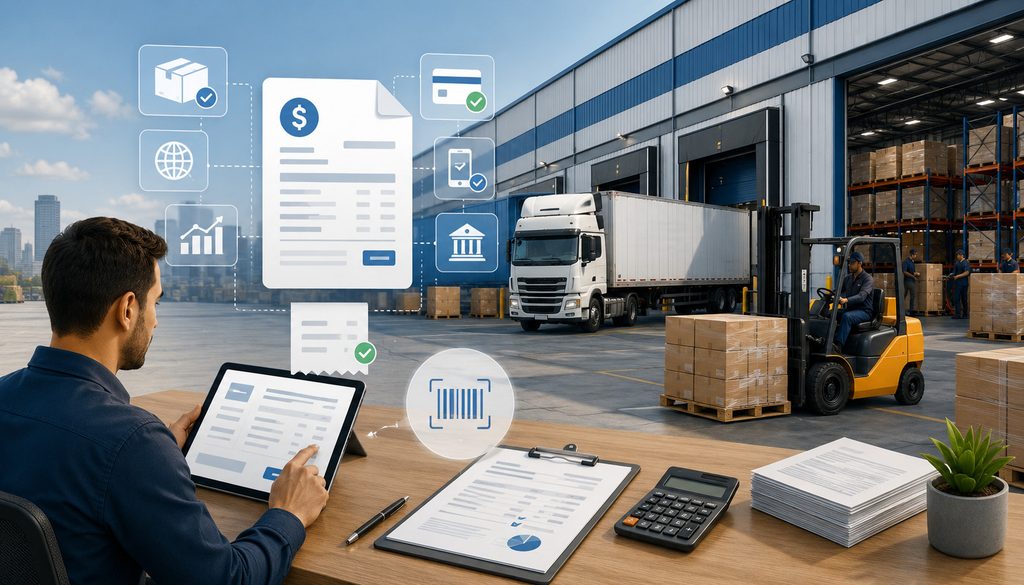
B2B payments logistics differ from ordinary checkout because the invoice itself is part of the payment system. The quality of the invoice affects approval speed, customer questions, remittance information, and ultimately reconciliation.
The final invoice should connect back to the underlying commercial event. Depending on the transaction and contract, documentation may include the customer account, invoice number, shipment or load reference, purchase order, bill of lading, service date, delivery information, and applicable accessorial charges.
Warehouse and Distribution B2B Invoicing
Warehouse and distribution billing can involve even more line items. Customers might be billed for storage, handling, fulfillment, pick-and-pack services, loading or unloading, transportation coordination, recurring account fees, packaging, or other contracted services.
The billing system should preserve enough identifiers to trace each charge. A monthly statement containing several warehouse activities, for example, should not become one unexplained amount that accounting cannot later connect to WMS records.
Electronic invoicing logistics workflows can improve consistency by generating an invoice from known operational data rather than re-keying it into an unrelated payment system. Integration can also provide customers with a secure payment link and carry the invoice identifier into the transaction.
Good warehouse and distribution B2B invoicing should support:
- customer account numbers;
- invoice identifiers;
- service or shipment references;
- purchase orders when applicable;
- due dates;
- credit memos;
- partial payments;
- customer deductions; and
- remittance references.
Freight Invoice Documentation
Freight invoice documentation matters before and after payment. Before payment, it helps the customer’s A/P team approve the charge. After payment, the same references enable payment-to-invoice matching and may help if a card transaction is later disputed.
A carrier should be able to move from an invoice number back to the underlying service documentation without searching unrelated emails. Where applicable, records might include the rate confirmation, signed agreement, bill of lading, proof of delivery, accessorial documentation, payment authorization, receipt, and correspondence.
This does not mean every dispute will be decided in the merchant’s favor. Evidence requirements depend on the card network and dispute reason. But maintaining orderly, transaction-specific documentation is substantially better than assembling a record after a dispute arrives.
Online Invoice Payments and Card-Not-Present Freight Transactions
A secure online invoice-payment workflow gives a logistics customer a direct route from the invoice to payment. Depending on the provider, the customer may be able to pay using a commercial card, ACH, or another supported method without sending sensitive account information to staff.
The payment page should carry an invoice or customer reference into the resulting transaction. Otherwise, the company may gain faster collection while creating a new reconciliation problem.
Card-not-present payments arise when a customer pays through:
- a secure online portal;
- an emailed link to a hosted payment page;
- a virtual terminal;
- a telephone payment processed by authorized staff; or
- an integrated invoicing application.
An emailed payment link is fundamentally different from asking the customer to email card numbers. The link should direct the payer to an approved secure payment environment; ordinary email should not be used as a repository for payment credentials.
Card-not-present freight payments should use appropriate fraud controls, access controls, transaction records, and authorization practices. Commercial familiarity with a customer is useful operational context, but it does not eliminate the need for payment security.
Virtual Cards
Some shippers and large commercial buyers pay suppliers using virtual card numbers. A virtual card may be single-use, limited to a specific amount, restricted by time or supplier, or otherwise controlled by the issuing program.
For accounts-receivable staff, the important question is not merely how to key the card. It is how the payment will be identified and matched.
The business should determine:
- which invoice the virtual card covers;
- whether one card covers multiple invoices;
- the authorized amount;
- the payment or remittance reference;
- how the payment will appear in settlement reporting; and
- how processing fees will be accounted for.
A secure virtual terminal or integrated B2B payment application is preferable to keeping card numbers in an email thread or spreadsheet.
ACH Payments for Trucking and Freight Invoices
ACH can be useful for B2B invoices, particularly when customers already operate electronic accounts-payable processes. But ACH should not be described as automatically cheaper, faster, safer, or better than a card in every circumstance.
The ACH Network supports business payment formats and remittance information that can facilitate electronic B2B payments. Nacha documentation includes business-oriented Standard Entry Class codes such as CCD and CTX and demonstrates that ACH messages can carry transaction identifiers and payment information.
A trucking or warehouse ACH workflow should address:
- authorization;
- bank/account information security;
- bank-account validation or verification where applicable;
- payment initiation;
- returns and exceptions;
- customer and invoice references;
- remittance information; and
- settlement reconciliation.
Authorization requirements should be handled according to the transaction and applicable Nacha rules. Nacha has emphasized that access to bank information by itself does not constitute authorization to initiate an ACH transaction.
Commercial Card vs. ACH
| Issue | Commercial Card | ACH |
| Speed/convenience | Familiar and often easy for buyer | Efficient for established B2B workflows |
| Processing cost structure | Card-based fees and interchange | Bank/provider ACH pricing |
| Buyer rewards/terms | May provide card-program benefits | Usually unrelated to card rewards |
| Remittance data | Invoice/customer data can be captured | Addenda/remittance information may be available |
| Return/dispute considerations | Card-network dispute framework | ACH returns and authorization rules apply |
| Security workflow | Secure gateway/terminal/tokenization | Secure bank-data collection and authorization |
ACH payments trucking operations receive should be reconciled with the same discipline as card deposits. A bank deposit without a reliable invoice reference still requires manual research.
Commercial Cards, Level 2 Data, and Level 3 Data
Commercial card acceptance can be valuable in freight and distribution because businesses may use purchasing cards, corporate cards, business cards, or virtual cards to pay suppliers. Some eligible commercial-card transactions support enhanced transaction data beyond an ordinary retail card payment.
Level 2 and Level 3 should not be confused with PCI merchant levels. In this context, the terms refer to enhanced commercial transaction data.
Level 2 Payment Data
Level 2 payment data generally provides additional business transaction information. Depending on the network, processor, card type, and transaction, examples can include tax information, customer codes, invoice numbers, or purchase references.
The exact fields and qualification requirements should be verified with the current processor and card-network rules. A processor’s documentation may simplify the concept for merchants, but eligibility can still differ by commercial-card product and transaction.
For logistics companies, the operational benefit goes beyond possible interchange qualification. Capturing a purchase-order or invoice reference can improve customer reporting and payment reconciliation.
A detailed internal discussion of Level 2 and Level 3 interchange optimization concepts explains common commercial-data fields. However, any savings examples on secondary sources should be treated as illustrative rather than guaranteed; current network and acquirer rules should control the actual qualification decision.
Level 3 Payment Data
Level 3 data provides more granular line-item information for eligible commercial transactions. Depending on the supported program, information can include item descriptions, quantities, unit prices, product or commodity codes, freight information, and other purchase details.
An authoritative processor guide from FIS likewise describes Level 3 processing as involving line-item detail for supported commercial cards and advises merchants to consult current network eligibility information.
For warehouse and freight companies, Level 3 integration can be easier when invoice line items already exist in an ERP, TMS, or billing platform. Manually entering detailed fields for every transaction can introduce errors and defeat much of the operational benefit.
| Area | Level 2 | Level 3 |
| Additional transaction detail | Summary business information | More detailed line-item information |
| Typical business use | B2B/B2G commercial payments | Eligible detailed commercial purchases |
| Integration complexity | Moderate | Usually greater |
| Potential qualification considerations | Depends on current rules and card | Depends on current rules, card, transaction, and complete data |
Can Level 2 or Level 3 Data Lower Processing Costs?
For certain qualifying commercial transactions, correctly submitted enhanced data may affect interchange qualification. It should never be presented as a guaranteed discount.
Qualification can depend on the commercial card, card network, merchant category, transaction type, data completeness, processor implementation, clearing rules, and current interchange program.
This distinction is important for distribution business payment processing because a merchant might spend heavily integrating Level 3 fields based on an assumed rate reduction that does not apply to its card mix.
Before implementing enhanced-data processing, ask the provider:
- which card products are eligible;
- which fields are required;
- which transactions qualify;
- how rejected or incomplete enhanced data is handled;
- how qualification appears in reporting; and
- whether the gateway, ERP, or virtual terminal actually transmits those fields.
Accounts Receivable Automation and Payment-to-Invoice Matching
Accounts receivable automation should connect payment collection with accounting rather than merely replacing a paper invoice with a PDF.
A useful target is:
Invoice → Payment Link → Payment → Remittance → Invoice Matching → GL Posting
The more reliably the invoice identifier survives this chain, the less manual intervention the finance team needs.
For each payment, retain at least:
- invoice number;
- customer account;
- payment transaction ID;
- payment method;
- payment date;
- amount;
- remittance reference; and
- settlement or deposit reference where available.
Common B2B Reconciliation Problems
Logistics accounts receivable rarely behaves like one invoice equals one payment. A shipper may pay ten freight invoices together. Another customer may deduct an agreed credit. Someone may short-pay an accessorial charge while it is being reviewed.
Common exceptions include:
- one payment covering multiple invoices;
- partial payments;
- short payments;
- customer deductions;
- unapplied cash;
- credit memos;
- incorrect invoice references;
- duplicate payments;
- processor batches containing transactions from several customers; and
- refunds that have not been linked back to the invoice.
A useful reconciliation table might look like this:
| Customer | Invoice | Shipment/Load Ref | Amount Due | Payment Method | Amount Received | Difference |
| Customer A | INV-10452 | LD-7813 | $8,500 | ACH | $8,500 | $0 |
| Customer B | INV-10471 | LD-7882 | $4,250 | Commercial card | $4,000 | $250 |
| Customer C | INV-10491 | Multiple | $12,900 | ACH | $12,900 | $0 |
Do not automatically write off differences. Route deductions, short pays, or unidentified remittances into an exception workflow.
Merchant Deposit and Daily Settlement Reconciliation
Card reconciliation requires more than comparing sales totals with the bank account.
The processor may group several transactions into one deposit. Fees may be deducted individually, from the batch, or through another billing arrangement. Refunds, reversals, disputes, adjustments, and timing differences can also cause the expected total to differ from the bank deposit.
A daily card settlement process should:
- export or review settled transactions;
- identify ordinary commercial, fleet, and fuel transactions;
- identify refunds and adjustments;
- account for applicable processing fees;
- calculate the expected deposit;
- match it to the bank deposit;
- match transactions to customer accounts or invoices;
- post the results to accounting; and
- investigate unresolved differences.
Fleet reporting can add another reconciliation dimension. When supported, richer data may allow a transaction to be connected to driver, vehicle, location, product, or fuel purchase.
Visa’s fleet documentation demonstrates how enhanced fleet information can be used for reporting, although the fields available depend on the specific program and merchant implementation.
Location-level reporting is particularly useful for multi-site I-81 corridor businesses:
| Location | MID/Location ID | Card Sales | Fleet/Fuel Sales | ACH Receipts | Open AR |
| Warehouse A | Location A | — | — | — | — |
| Terminal B | Location B | — | — | — | — |
| Service Facility C | Location C | — | — | — | — |
Separate merchant IDs or location identifiers can improve reporting when they reflect legitimate operating structures. Extra MIDs should never be created to evade underwriting, monitoring, chargeback controls, or other processor requirements.
TMS, WMS, ERP, and Integrated Payment Workflows
Integration can substantially improve payment reconciliation when systems share stable references.
A transportation management system may already contain the customer, shipment, load, rate, accessorial charges, and invoice total. Instead of retyping those fields into an unrelated payment portal, an integration can pass suitable references into an invoice and payment workflow.
TMS and WMS Payment Integration
A TMS integration can potentially pass:
- customer ID;
- load or shipment ID;
- invoice number;
- amount due; and
- payment status.
A warehouse management system can perform a similar role for storage, handling, fulfillment, inventory services, and customer-account billing.
The exact capabilities depend on the software and integration. Do not assume every TMS or WMS provides bidirectional, real-time synchronization.
An integration should define which system is the source of truth. For example, the TMS might own freight charges, while the ERP owns the customer receivable and the payment platform owns the processor transaction ID.
ERP Integration and Webhooks
ERP integration can help synchronize:
- open A/R;
- customer accounts;
- payment references;
- processing fees;
- settlements;
- credit memos;
- refunds; and
- customer balances.
APIs and webhooks may be used to update payment status automatically. A webhook might tell the billing system that a payment succeeded, failed, or was refunded.
However, one callback should not be treated as the final accounting record. Network interruptions, duplicate events, integration defects, or delayed updates can occur. Businesses should periodically reconcile the processor or bank’s authoritative settlement records against the ERP.
A payment marked “paid” in the customer portal but absent from settled transactions should be investigated rather than assumed complete.
Payment Security, PCI DSS, and Card-on-File Practices
Every logistics company accepting payment cards has security responsibilities appropriate to its card-data environment. PCI DSS applies to environments that store, process, or transmit payment card account data, with the specific validation requirements depending on the setup and relationships involved.
PCI guidance prohibits storing sensitive authentication data such as card verification codes after authorization, even if encrypted. The currently applicable PCI DSS framework should be obtained through the PCI Security Standards Council and evaluated with the organization’s acquirer or qualified security resources.
Dispatch software, spreadsheets, ticket notes, ordinary email, and shared documents should not become improvised card vaults.
Do not store:
- CVV/CVC/CID after authorization;
- photographs of payment cards;
- full card numbers in free-text dispatch notes;
- emailed card authorization forms containing unnecessary sensitive information; or
- reusable payment credentials in ordinary spreadsheets.
Use approved payment terminals, hosted payment pages, secure virtual terminals, and tokenization where appropriate.
Card on File for Commercial Customers
Tokenized card-on-file functionality can make recurring B2B payments more efficient. Instead of retaining the actual card number in the merchant’s application, the payment system can provide a token that represents the credential within an approved payment environment.
Saving a card does not create unlimited permission to charge any amount at any time. The merchant should establish appropriate customer authorization covering how the credential may be used.
Variable invoice amounts deserve particular attention. The company should define whether the customer has authorized automatic payment, must approve each invoice, or has agreed to another recurring payment arrangement supported by the provider.
Fraud, Disputes, and Invoice Bank-Change Scams
Logistics businesses face payment fraud both on cards and outside card networks.
Fleet and fuel controls can help restrict inappropriate use when supported by the card program. Fleet managers may use driver controls, vehicle identifiers, purchase-category restrictions, account alerts, and transaction monitoring to identify unexpected activity.
Those controls should be managed defensively. Fraud rules should not be published with thresholds precise enough to help attackers design transactions around them.
Corporate payment fraud may also involve compromised purchasing cards, account takeover, stolen virtual-card details, or manipulated accounts-payable instructions.
Do Not Trust Bank Changes Sent Only by Email
Invoice and bank-change fraud deserves special attention because a criminal may never touch the merchant’s payment system.
A common business-email-compromise scenario involves a fraudster impersonating a supplier, employee, executive, or customer and requesting a change to bank or remittance instructions. A convincing email thread does not independently establish that the change is legitimate.
Changes involving ACH instructions, bank account details, or remittance destinations should be verified through a trusted channel.
Controls can include:
- callback verification using a previously known phone number;
- dual approval for bank-detail changes;
- authenticated supplier or customer portals;
- separation of request and approval duties;
- audit logs; and
- alerts for newly changed payment instructions.
Do not use a phone number contained only in the suspicious change request as the verification source.
Card Disputes and Documentation
Ordinary commercial-card disputes can involve unauthorized transactions, duplicate charges, incorrect amounts, cancellation claims, or alleged non-performance.
Potential supporting records include:
- signed agreements;
- invoices;
- transaction receipts;
- authorization records;
- rate confirmations;
- proof of delivery;
- bills of lading where relevant;
- service documentation; and
- customer correspondence.
Fleet/fuel products may have network-specific dispute processes. Merchants should follow the current rules of the actual card product rather than applying an ordinary consumer-card procedure automatically.
Refunds, Credits, Processing Costs, and Cash Flow
Refunds should preserve the link between accounting and the original payment.
Depending on the situation, a customer adjustment might involve a card refund, an ACH payment or credit process, a credit memo, a partial refund, or an offset against another invoice. The accounting system should identify which invoice and payment the adjustment affects.
Before issuing money, confirm whether the invoice has already:
- received a credit memo;
- been refunded;
- entered a card dispute;
- been offset against another balance; or
- been partially reversed.
That reduces the risk of a duplicate reimbursement.
Effective Payment Cost
Payment cost should not be evaluated by one advertised transaction rate.
Possible cost components include:
- interchange;
- network assessments;
- processor markup;
- gateway or virtual-terminal charges;
- applicable fleet-network fees;
- ACH provider fees;
- invoicing platform costs; and
- integration costs.
A useful basic measure is:
Effective Payment Cost = Total Payment Acceptance Cost ÷ Total Collected Volume × 100
For B2B collections, an even broader view is helpful:
Total Cost of B2B Collections = Payment Cost + AR Labor + Collection Delay + Reconciliation Effort + Bad-Debt/Dispute Risk
An ACH payment that requires extensive manual research is not operationally “free.” Conversely, a commercial card that carries a higher transaction cost may still have value if the customer pays immediately instead of remaining in aging for an extended period.
Electronic payments can reduce collection delays when customers adopt them, but no specific reduction in days sales outstanding should be promised.
A/R aging remains useful:
| Customer | Current | 1–30 Days | 31–60 Days | 61–90 Days | 90+ |
| Customer A | — | — | — | — | — |
| Customer B | — | — | — | — | — |
Payment Terms, Discounts, Surcharges, and Multi-State I-81 Operations
Commercial payment terms should be established by contract and credit policy. Net 15, Net 30, or longer terms simply describe when payment is due under the agreement; they do not automatically determine which payment method should be used.
Businesses may also offer legitimate early-payment discounts. For example, a customer might receive a contractual invoice discount for paying before a specified date. That is conceptually different from imposing a surcharge on a card transaction.
Card surcharges and convenience fees require greater caution. Applicable network rules, card type, disclosure requirements, processor capability, and state law must all be checked before implementation.
An I-81 corridor company should not assume that the same surcharge policy can be deployed unchanged across Maryland, Pennsylvania, West Virginia, Virginia, Tennessee, or other locations.
Multiple Locations, MIDs, and Reporting
A logistics organization may have:
- a warehouse;
- a terminal;
- a repair shop;
- a distribution center;
- a sales office;
- an ecommerce channel; and
- mobile operations.
Separate location reporting or merchant profiles can help finance teams understand where revenue originated. In appropriate cases, separate MIDs may be used as part of a legitimate processing structure approved by the acquirer.
The structure should correspond to the real business. Opening additional accounts to conceal volume, isolate problematic transactions improperly, avoid monitoring, or work around underwriting restrictions is inappropriate.
Tax configuration can also differ by location and transaction, but payment processing should not be treated as a substitute for tax advice.
Freight Billing Workflow and Payment Reporting Dashboard
A disciplined freight billing workflow ties operations, invoicing, collection, and accounting together.
A practical nine-step process is:
- Capture service or order details: Preserve the customer, shipment, rate, and required references.
- Finalize charges: Add authorized accessorial or other final service charges.
- Generate an accurate invoice: Avoid re-keying data where integrations can transfer it reliably.
- Send secure payment options: Provide an approved portal or payment link for electronic payment.
- Collect remittance information: Require an invoice, shipment, or customer reference.
- Match payment to invoice: Apply full and partial payments to the correct receivable.
- Investigate deductions: Route short pays and discrepancies to an exception queue.
- Reconcile settlement: Match processor or bank settlement to the recorded transaction.
- Post to the general ledger: Account for payment, fees, refunds, adjustments, and outstanding balances.
A payment dashboard should reveal operational exceptions, not merely total sales.
Useful metrics include:
| Metric | Why It Matters |
| Open A/R | Shows unpaid customer balances |
| Days outstanding | Indicates collection timing |
| Electronic payment adoption | Shows use of card/ACH workflows |
| Unmatched payments | Identifies reconciliation failures |
| Failed payments | Highlights collection exceptions |
| Processing cost | Tracks payment-acceptance expense |
| Dispute volume | Shows payment and service risk |
Avoid arbitrary benchmark targets unless they come from reliable company-specific historical data or a genuinely comparable industry source.
A customer payment portal can support this workflow by giving authorized users access to invoice history, secure card or ACH payment, tokenized saved methods where appropriate, receipts, and downloadable documentation.
Commercial portals should also use role-based access. The individual allowed to view an invoice may not need permission to change bank details or saved payment credentials.
Common Payment Mistakes in Logistics Businesses
Many payment problems arise not because a transaction rail is inherently unsuitable but because the supporting workflow was poorly designed.
Common mistakes include accepting a fleet card program without verifying processor support, assuming every fuel card behaves like an ordinary Visa or Mastercard transaction, and enabling unnecessary prompts that slow warehouse or fuel-counter transactions.
Other recurring problems include:
- failing to capture invoice or load references;
- emailing card forms or retaining payment information in inboxes;
- storing card numbers in dispatch notes;
- treating Level 3 data as a guaranteed interchange discount;
- failing to reconcile processor batches with bank deposits;
- applying an unsupported surcharge;
- accepting changed bank instructions without independent verification;
- leaving one customer payment unmatched across several invoices;
- losing the connection between refunds and original invoices;
- assigning transactions to the wrong MID or location;
- failing to reconcile ACH remittance data; and
- assuming one payment integration is the authoritative source for settlement.
A good logistics payment workflow is designed for exceptions. It assumes that a customer will sometimes short-pay, a virtual card may cover several invoices, a processor batch may contain multiple customers, and an integration event may occasionally fail.
Reliable operations emerge when the business can detect those exceptions quickly.
Payment Setup Checklist and Questions for Your Provider
Before implementing warehouse payment processing, trucking payment processing, or fleet payment processing, document what the business actually needs.
| Area | What to Verify |
| Fleet card networks | Exact programs customers use and processor support |
| Fuel card support | Network enrollment and merchant eligibility |
| Commercial cards | Supported brands and commercial products |
| ACH capability | Authorization, payment collection, returns, reporting |
| Level 2/3 support | Eligible cards, required fields, gateway transmission |
| Secure invoice payments | Hosted page or approved portal |
| TMS/WMS/ERP integration | Supported fields and source-of-truth rules |
| Customer references | Invoice, load, PO, shipment, account IDs |
| PCI controls | Card-data scope and secure handling |
| Refund workflow | Link refund to original payment/invoice |
| Settlement reporting | Batch and deposit detail |
| Location/MID mapping | Correct facility and account configuration |
| AR reconciliation | Full, partial, multi-invoice, and unmatched payments |
| Fraud controls | Access, alerts, approval, bank-change verification |
Questions worth asking a payment provider include:
- Which specific fleet cards can we accept?
- Which fuel-card networks are supported?
- Does our terminal or POS support applicable fleet prompts?
- Can driver, vehicle, unit, or odometer information be captured where required?
- Do you support Level 2 and Level 3 commercial-card data?
- Which transactions currently qualify for enhanced commercial-card interchange programs?
- Can invoices offer both card and ACH?
- Can the invoice number flow into settlement reporting?
- Can payment references sync with our TMS, WMS, ERP, or accounting system?
- Can one customer payment be allocated across multiple invoices?
- How are virtual cards processed?
- Can commercial payment credentials be tokenized?
- How are disputes and chargebacks reported?
- Can reports be segmented by warehouse, terminal, location, or MID?
- How do processing fees appear in settlement reports?
Do not accept generic “yes, we support B2B” answers when an operational detail matters. Ask the provider to demonstrate how the field appears in the payment interface and the final settlement report.
Frequently Asked Questions
What payment methods should trucking businesses accept?
Most trucking companies benefit from supporting more than one method. Depending on their customers, this may include commercial credit cards, ACH, secure online invoice payments, checks, wires, virtual cards, and specialized fleet or fuel cards where operationally relevant.
The best mix depends on invoice sizes, customer preferences, collection timing, processing costs, security requirements, and reconciliation needs.
What is a fleet card?
A fleet card is a business payment product designed around vehicle-related spending. Depending on the program, it may support controls or reporting associated with drivers, vehicles, purchase categories, fuel, maintenance, locations, or other fleet information.
These capabilities are program-specific, and a merchant should verify acceptance and required data with its processor and the relevant fleet network.
What is the difference between a fleet card and a fuel card?
The terms overlap, but they are not always interchangeable. Fleet cards typically focus on broader vehicle-related expense management, while some fuel cards are primarily designed for fuel purchases or a specific fuel network.
Either product may be proprietary, closed-loop, fleet-oriented, or network-branded, so acceptance and functionality must be verified for the specific card.
Can any merchant automatically accept fleet cards?
No. Accepting ordinary Visa, Mastercard, or other payment cards does not necessarily enable every specialized fleet product.
Acceptance can depend on the card program, merchant category, acquirer/processor configuration, network participation, terminal software, and data capabilities. Merchants should identify the cards their customers use and confirm specific support.
How do I accept fuel cards at my business?
Start by identifying the exact fuel-card programs customers want to use. Ask the processor or acquirer whether each program is supported, verify merchant and terminal eligibility, complete any necessary enrollment, configure applicable prompts, and test authorization and settlement. Confirm that the resulting reports contain the information your accounting team expects.
Do fleet cards require special POS prompts?
Some do. Depending on the program, transaction, and merchant, the POS may request information such as driver identification, vehicle or unit number, odometer, purchase type, or other fleet data. Exact requirements differ, so merchants should not configure prompts based on a generic fleet-card checklist alone.
What are Level 2 and Level 3 commercial-card payments?
Level 2 and Level 3 refer to enhanced commercial transaction information, not PCI merchant levels. Level 2 commonly adds summary business fields such as tax or customer references. Level 3 can add more detailed line-item data. Availability, required fields, and qualification rules depend on the network, processor, card, and transaction.
Can Level 3 data reduce payment-processing costs?
Potentially, for certain eligible commercial-card transactions under current network and acquirer programs. It is not a universal discount. Merchants should verify which cards and transactions qualify, which fields must be submitted, and whether their gateway actually transmits valid enhanced data before estimating savings.
Is ACH a good option for trucking and freight invoices?
ACH can be useful for established B2B customers, especially for larger or recurring invoices. The business still needs appropriate authorization, secure handling of banking information, return management, remittance references, and reconciliation.
ACH should be evaluated alongside cards and other methods rather than assumed to be automatically superior.
How should logistics companies accept large B2B invoices online?
Use a secure invoice portal or hosted payment page that supports approved payment methods such as commercial card or ACH. The payment should carry the invoice or customer reference into transaction reporting. Avoid collecting card information through ordinary email, spreadsheets, or dispatch notes.
Can transportation businesses keep customer cards on file?
A properly implemented tokenized card-on-file system can support recurring commercial customers. Businesses should obtain appropriate authorization and use secure payment-provider functionality rather than retaining raw card numbers. A stored credential should not be interpreted as unlimited permission to charge unrelated or unapproved amounts.
How should warehouse and freight payments be reconciled?
Match each payment to the customer, invoice, shipment or load reference, amount, payment method, transaction ID, and remittance information. Then reconcile processor settlement or ACH activity against the bank deposit and general ledger. Unmatched, partial, or short payments should enter an exception workflow rather than remain indefinitely unapplied.
What documentation helps with a B2B card dispute?
Depending on the dispute’s reason and network rules, useful documentation may include the signed agreement, invoice, authorization record, transaction receipt, rate confirmation, bill of lading, proof of delivery or service, and customer correspondence. Merchants should follow the specific card network’s current evidence and response requirements.
How can logistics companies prevent invoice-payment fraud?
Use independent verification for bank-detail changes, dual approvals where appropriate, trusted callback numbers, authenticated portals, role-based access, and audit logs. Do not rely solely on emailed bank-change instructions, even when the message appears to come from a known vendor or employee.
Can one payment system support multiple I-81 corridor locations?
Often yes, but the architecture depends on the provider, business entities, locations, merchant profiles, settlement accounts, and reporting requirements. A multi-location setup should clearly map each transaction to the correct warehouse, terminal, channel, or MID without using extra merchant accounts to circumvent underwriting or risk controls.
Conclusion
Payments for warehouse, trucking, and distribution businesses on the I-81 corridor work best when collection and reconciliation are designed together.
Fleet cards for logistics companies can provide valuable vehicle-related controls and reporting, but acceptance depends on the specific card program, merchant setup, processor, and POS configuration.
Fuel card acceptance likewise requires program-level verification rather than an assumption that every commercial fuel card behaves like an ordinary payment card.
B2B invoicing trucking businesses should preserve customer, invoice, shipment, load, purchase-order, and remittance references from the initial service record through payment and settlement. Commercial cards, virtual cards, ACH, checks, wires, and online invoice payments can all play appropriate roles depending on customer needs.
Enhanced Level 2 and Level 3 commercial data may improve transaction detail and, for qualifying transactions, may affect interchange qualification. No cost benefit should be promised without reviewing current network and acquirer requirements.
The strongest logistics payment operation ultimately follows one consistent chain:
Customer/Carrier/Shipper → Invoice or POS Transaction → Payment Method → Authorization → Commercial/Fleet Data → Settlement → Remittance → AR Matching → General Ledger
That structure gives transportation and distribution companies something more useful than payment acceptance alone: a reliable way to understand exactly who paid, what they paid for, where the money settled, and which receivable can be closed.
Informational disclaimer: This article provides general payment-operations, security, and compliance information and is not legal, tax, accounting, banking, or financial advice. Card-network rules, fleet and fuel card programs, ACH requirements, processor capabilities, state laws, fees, and commercial-payment programs can change.
Businesses should verify current requirements with their acquirer, payment provider, card network, financial institution, qualified compliance professionals, and legal or accounting advisers as appropriate.